
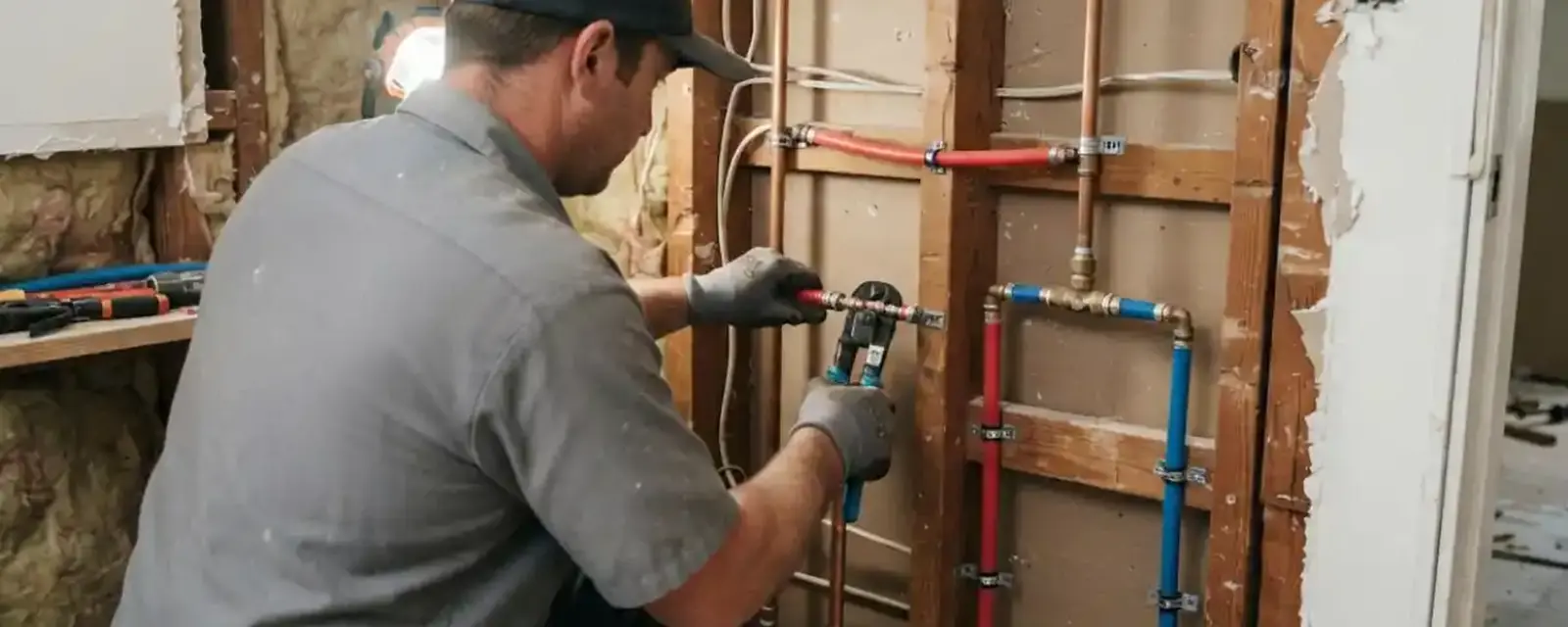
One pinhole leak is a repair. A second one in a different room six months later is a pattern. Repiping in Chesterfield, MO starts when the pipes themselves, not a single joint, are the problem, and the water coming from the tap is often the first clue.
Brown or rusty water after sitting overnight, pressure that falls when two fixtures run, and green crust on copper joints all point toward the supply lines. We find the cause first. Replacing every pipe in a house is a large job, and it should only happen when spot repairs have stopped making sense.
Signs the supply pipes may be failing
Any one of these can have a smaller cause. Together they usually point to old or damaged supply lines.
Rusty or brown water
Water that runs orange or brown for the first few seconds, especially after the house has been empty, suggests corroding steel or iron pipe.
Pressure drops when two things run
Mineral and rust buildup narrows old galvanized pipe from the inside, so a shower slows when the washer fills.
Pinhole leaks in different spots
A damp ceiling stain, a wet baseboard, then another leak elsewhere. Copper can fail from the inside in a pattern called pitting.
Metallic taste or smell
Corroded pipe can change the taste. A test of your tap water can show what is in it.
Stains, bulges or flaking on exposed pipe
Visible rust, white mineral crust or green corrosion on joints means the metal is wearing out.
How we decide whether you need a repipe
A diagnosis comes before any quote. We shut off the water, put a pressure gauge on an outside hose bib, and watch what the pressure does when other fixtures open. Low pressure at the street shows up at every tap, while low pressure only in old pipe runs shows up where the pipe is narrowed.
We also unscrew an aerator, check for scale or rust flakes and look at the pipe where it is exposed in a basement or crawl space. Where a leak is hidden, a moisture meter or an acoustic listening device helps find it before any wall is opened. Our leak detection page explains that process.
If a single section has failed and the rest of the pipe looks sound, we say so and repair that run. A full repipe is the right answer when the metal is failing all over, not when one elbow cracked.
How to find out what pipe you have
Pipe material depends on the year the house was built and what has been replaced since. Check yours before you call.
| Where to look | What you may see | What it tells you |
|---|---|---|
| Pipe near the water meter or main shutoff | Gray and dull, threads at the joints | Galvanized steel. A magnet sticks to it. |
| Same spot | Copper-colored, solder at the joints | Copper. A magnet does not stick, and scratching shows a copper shine. |
| Same spot | Flexible plastic in red, blue or white | PEX. Usually newer or a past repipe. |
| Same spot | Rigid white, cream or gray plastic | CPVC or PVC, used for various supply and drain lines. |
| Under sinks | Chrome supply stubs | These do not reveal the wall pipe. Check the basement or crawl space. |
Different parts of one house can have different pipe. An addition, a bath remodel or an earlier repair may have swapped sections without telling you.
Brown water or low pressure everywhere?
Old galvanized or failing pipes show it in more than one fixture.
PEX or copper: an honest comparison
Both materials work and neither is right for every house. Here is how they compare.
PEX
- Flexible tubing that bends around framing, so less wall opening
- Resists splitting from a freeze better than rigid pipe, but not immune
- Faster to install, which usually trims labor
- Must not be exposed to sunlight, and some chlorine and fuel exposures are a concern
Copper
- Long-used metal pipe with a strong track record
- Takes heat well and does not degrade in sunlight
- Soldered joints take more time and a skilled hand
- Material is costly, and aggressive water can cause pitting over decades
How a repipe goes, room by room
The work is organized so the house stays usable for as much of it as possible.
Walk the house
We trace where supply lines run, mark fixtures and decide where access holes make sense. Plans differ in a slab house, a basement house and a two-story.
Shut off and drain
The main is closed, the system drained and the old water heater connections are noted before cutting.
Run new lines
New lines are routed through basements, crawl spaces and attics first. In-wall runs reach fixtures through small access cuts.
Connect fixtures and test
Each fixture gets a new stop valve and supply line. The system is pressure tested before any wall is closed.
Patch the openings
Drywall openings are patched and prepared for paint. Finish painting and texture matching are usually separate trades.
What a repipe costs depends on the house
No price over the phone can be honest, since two houses with the same square footage can need very different work.
Homeowners policies commonly cover sudden accidental damage but not replacing pipes that wore out from age, so check yours before assuming cost is covered.
Want the real number for your job? Call the 24/7 line, describe the work, and hear a clear price before anything starts.
Permits, licensing and your water utility
Permit rules vary, so ask the City of Chesterfield or St. Louis County before work that may need a permit. Plumber licensing in Missouri is set locally, so confirm any plumber's licence with the building department where the job is. If low pressure is on the street side, ask Missouri American Water whether the problem is at the main or inside your house.
When a repipe is not the answer
Replacing every pipe is the last option, not the first. These cases usually have a smaller fix.
- ✓A single leak in otherwise sound pipe
- ✓Low pressure at every fixture, which can be a failing pressure regulator at the main
- ✓Rust-colored water only on the hot side, which can come from the water heater tank
- ✓A clogged aerator or showerhead
- ✓A partly closed shutoff valve
Questions about repiping in Chesterfield
Look for rusty water, falling pressure and leaks that keep returning in different places. A plumber then tests pressure and checks the pipe before suggesting any replacement.
Pipe material depends on the year the house was built and what was replaced since. Check near the meter, and we confirm in person.
Some access holes are needed, but PEX often needs fewer than rigid pipe. We tell you where we will cut before starting, and we patch the openings.
No. A pressure regulator, a half closed valve or a clogged aerator can also cause it. We test with a gauge before suggesting a repipe.
Usually yes, though water is off for part of the day. We plan the shutoffs and tell you ahead of time.
Yes. We serve nearby towns, including Creve Coeur and Ballwin.
Reference points for this page: The Uniform Plumbing Code (UPC) and the International Plumbing Code (IPC) are the model codes most U.S. jurisdictions adopt, and the local permitting authority decides which edition and amendments apply. Water hardness figures come from Missouri American Water and its 2021 water quality report for the St. Louis region.