
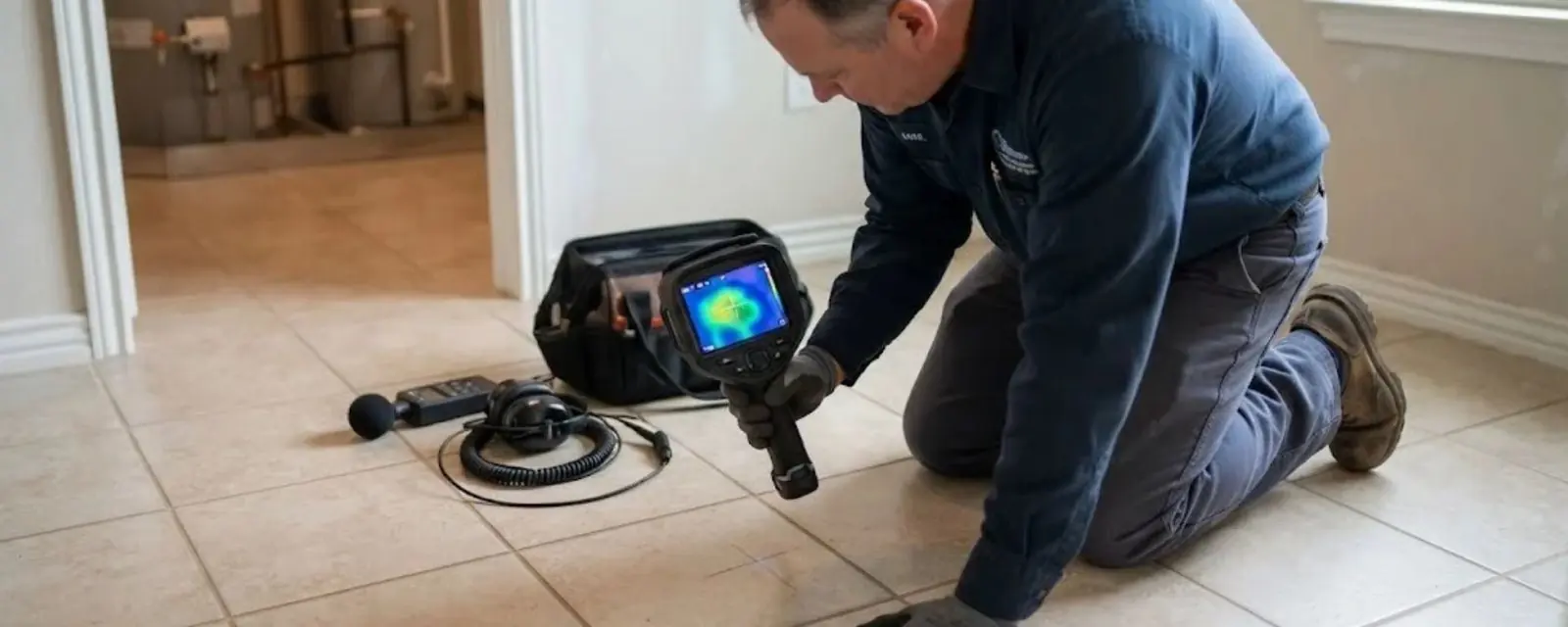
The water bill doubled and nobody can say why. The meter dial keeps spinning with every faucet off. A ceiling stain grows after each shower, or a patch of floor feels warm in January. These are the signs that bring people to leak detection in Chesterfield, MO, and every one of them means water is going somewhere it should not.
If the leak is active, call the 24/7 line now and close the main shutoff while you wait. We book same-day visits when available. The rest of this page explains how leaks are confirmed, which tools find them without tearing out drywall, and which cases are slab, buried line or something else entirely.
Signs you have a hidden leak
Some leaks announce themselves. Most do not. These are the signals worth acting on.
The meter moves with everything off
A dial or a small triangle that spins when no water is in use means water is leaving the system somewhere between the meter and your fixtures.
The water bill jumps with no change in habits
A bill that rises for a month or two without guests, a new pool or a lawn is a leak until proven otherwise.
Stains on ceilings and walls
Brown rings, bubbled paint or soft drywall mean water has been present long enough to soak in. Active leaks usually grow after use.
A warm or damp spot on the floor
A patch of floor that is warm underfoot can point to a hot water line running in or under the slab.
The sound of running water in a quiet house
A faint hiss or trickle at night, with all fixtures closed, points to a pressurized line leaking inside a wall or under the floor.
Low pressure or a musty smell
A drop in pressure, mold odor or a sudden patch of wet or green lawn along the path of the water line deserves a look.
How to confirm a leak yourself with a meter test
This takes about an hour and costs nothing. It tells you whether water is leaking past your meter before you spend on a search.
- ✓Turn everything offClose every tap, pause the dishwasher and washing machine, shut off the ice maker, turn off irrigation and make sure no one flushes.
- ✓Find the meterIt sits in a box near the street or in the basement or garage. Lift the lid carefully, since spiders and soil are common.
- ✓Read the low-flow indicatorLook at the small dial or triangle. If it spins with all water off, water is moving.
- ✓Note the reading and waitWrite down the numbers, wait 30 to 60 minutes without using water, and read again.
- ✓Close the main and repeatIf the dial still moves with your main shutoff closed, the leak is in the line between the meter and the house. If it stops, the leak is inside the house.
- ✓Rule out the usual suspectsAdd a few drops of food coloring to each toilet tank and wait 15 minutes. If color reaches the bowl, the flapper is leaking and that may be the whole story.
When a hidden leak is an emergency
A leak becomes urgent when water is damaging something right now: a ceiling bulging with water, a wet wall near outlets, a basement floor that is spreading, or a bill that suggests hundreds of gallons a day. Close the main shutoff, open a low faucet to bleed pressure, and call the 24/7 line.
Never push on a bulging ceiling or stand beneath it. A wet ceiling with a light fixture can be an electrical hazard, so keep the lights off, and shut off the breaker only if the panel is dry and reachable.
- 1Close the mainThe valve is usually near the meter or where the line enters the house. Test it now so you know it turns.
- 2Protect the areaMove furniture, set buckets under drips and keep people out from under any bulging ceiling.
- 3Document itPhotograph stains and the meter reading for your insurer before anything is cleaned or opened.
Meter moving with everything off?
That is the classic sign of a hidden leak, and tools can find it without tearing out walls.
Water meter still running or a high water bill
Your meter is the most honest instrument in the house. If the low-flow indicator moves with all water off, you have a confirmed leak. The first split is whether it is inside the house or on the line outside, and the closed-main test above answers that.
A high bill with a meter that has stopped spinning points to something else: a toilet that runs on and off, an irrigation zone, a softener regeneration, a pool refill, or a billing error. Check those, and ask your water utility how it estimated the bill. Missouri American Water can tell you whether your usage pattern looks like continuous flow.
Ceiling and wall leaks
Water rarely appears where it starts. It runs along a joist or a pipe and stains the ceiling several feet away. We use a moisture meter, pin and pinless, to map the wet area, then a thermal imaging camera to see temperature differences that show where moisture sits behind drywall.
A ceiling stain under a bathroom usually points to a shower pan, a tub drain, a supply line or a toilet flange. Under a kitchen it often points to a dishwasher line or sink drain. Roof leaks and condensation from an air handler also mimic plumbing leaks, so we rule those out before cutting. The aim is a small, accurate opening, not a large one.
Leaks under the house, in the crawlspace, basement or slab
In a crawlspace or an unfinished basement, a lot of the pipe is visible. We check for drips, wet insulation, rust streaks and fresh mineral stains, then follow the line with a flashlight and a moisture meter. This is the cheapest kind of leak to find and the cheapest to fix.
Slab leaks are the hardest. Slab leak detection is covered here as a section, not a separate service. Pipes in or beneath a concrete floor are found with acoustic listening and thermal tools, not by guesswork. A hot water line leaking under a slab may warm the floor and raise your gas or electric bill. A cold line leak shows as a meter that runs and sometimes a damp patch.
Once the line is isolated and the sound located, we mark the floor so any repair can be a small opening. Depending on the damage, the options are an access repair, rerouting the line overhead, or in older homes with repeated failures, repiping.
Underground leaks on the water service line from meter to house
The service line runs from the meter, often at the curb, to the house. It is buried, so a leak shows up as a spinning meter with a closed main, a soggy patch of lawn, a pressure drop or a sinkhole-like depression. It may also show up as nothing at all, because soil drains water quietly.
We confirm the line is the culprit by shutting the main and watching the meter. Then a ground microphone and acoustic correlator listen along the line for the hiss of escaping water. A pipe locator traces the route, and a pressure gauge on a hose bib shows whether the line holds pressure. Tracer gas can help when the sound is faint.
Who owns which part of the line varies, so ask Missouri American Water where its responsibility ends and yours begins before you dig. A buried leak can be repaired in a short trench or replaced from end to end, depending on pipe condition.
The tools used to pinpoint a hidden leak
Each instrument sees a different part of the problem. Using more than one confirms a leak before anyone cuts anything.
| Tool | What it finds | Where it falls short |
|---|---|---|
| Acoustic listening and ground microphone | The hiss or drip of pressurized water in buried or slab pipe | Traffic, wind and plastic pipe muffle the sound |
| Thermal imaging camera | Temperature differences from hot lines, or moisture cooling a surface | Needs a contrast in temperature and cannot see deep into concrete |
| Moisture meter, pin and pinless | Water inside drywall, wood and subfloor | Reads moisture, not its source |
| Pressure testing | Whether an isolated line holds pressure or loses it | Tells you a leak exists, not where it is |
| Tracer gas | Small leaks, by releasing a harmless hydrogen blend and sniffing for it at the surface | Takes setup time and the line must be isolated |
| Pipe locator and camera | Route of buried lines and the inside of drain pipes | A camera cannot find a pressurized supply leak |
How a leak search is carried out
Listen to the story
When it started, where the signs are, whether the bill changed and whether any fixtures are acting up.
Confirm with the meter and pressure
We repeat the meter test and put a gauge on a hose bib to check how the system holds pressure.
Isolate sections
Valves are closed in turn to separate the hot side from the cold, the house from the service line, and one zone from another.
Pinpoint with the right tool
Acoustic gear for buried and slab lines, thermal and moisture tools for walls and ceilings, tracer gas when sound is not enough.
Report and quote
You get the location, the cause, the repair options and the price before anything is opened or dug.
Yard, irrigation, meter box and pool leaks
Irrigation leaks are common because lines are shallow and valves are buried in boxes. A stuck zone valve, a cracked head or a broken fitting can run all day. Turn the system off, repeat the meter test, and look for pooling near heads. In winter, drain and shut down the system, since frozen irrigation lines crack.
Meter box leaks happen at the fittings on either side of the meter. If the box is full of water, the meter dial keeps moving, or you hear a hiss at the curb, the leak may be on the utility's side or yours. Call Missouri American Water and describe what you see.
If you have a pool or spa, a leak in the plumbing lines is a separate case from a leak in the shell, and the bucket test tells them apart. We handle the house side of the plumbing, so ask a pool specialist about the shell.
Why low-lying Chesterfield property can fool a leak search
Chesterfield Valley is low Missouri River floodplain. During the Great Flood of 1993, the Monarch levee gave way the night of July 30, and about 4,000 acres of the Valley flooded to depths of 6 to 15 feet. The Valley is now protected by the Monarch-Chesterfield Levee.
For a basement or slab in low ground, that history matters when water shows up where it should not. Groundwater, a failed sump pump or a drain problem can mimic a pipe leak, so we run the meter test first. A meter that stays still points away from the supply pipes toward drainage, and a sump pump or basement waterproofing may be the real fix.
Commercial leak detection
Retail, offices and mixed buildings in places like Chesterfield Valley have larger lines, more fixtures and often several water meters. We can run meter and pressure tests and trace leaks in small commercial buildings. Fire lines, multi-tenant buildings and large-diameter mains are scoped on a site visit, and some specialist work may need another contractor. See our commercial plumbing page for building-level service.
What affects the cost of leak detection
We quote after we see the situation, because a leak under a tub and a leak under a driveway are not the same job.
Homeowners insurance commonly covers sudden accidental water damage, and some policies cover the cost of locating the source. It generally does not cover a slow leak that went unrepaired or the pipe itself. Ask your insurer before work starts.
Want the real number for your job? Call the 24/7 line, describe the work, and hear a clear price before anything starts.
When leak detection is not the right step
If water is visibly spraying from a pipe, skip the search and go straight to burst pipe repair. If the leak is at a water heater, start with water heater repair. And if the meter stays still and the symptoms point to a drain or the roof, detection will not find anything and we will say so.
We also do not open walls on a hunch. If the evidence is thin, we monitor with a pressure test and recheck before cutting. Homeowners in Wildwood and other nearby towns get the same process.
Questions about leak detection in Chesterfield
Yes. The 24/7 line is open around the clock, and we book same-day visits when the schedule allows. Close the main shutoff while you wait.
A warm spot on the floor, the sound of water with everything off, and a meter that runs with the main open are the signs. We confirm with a pressure test, then locate it with acoustic and thermal tools.
Usually the search itself is non-invasive. Moisture meters, thermal cameras and listening devices work from the surface, and we open only the spot that is confirmed.
Low pressure can come from a leak, a partly closed valve, a failing pressure regulator or mineral buildup in old pipes. A gauge on a hose bib and the meter test separate those causes.
Check toilets, irrigation, softener cycles and recent fills. Ask Missouri American Water how the bill was calculated, since a stalled meter points away from a pipe leak.
It depends on where the leak sits relative to the meter and the property line. Ask Missouri American Water before digging, and we can help document what we find.
We handle the plumbing lines on the house side. A leak in the shell or the pool equipment pad is usually a pool specialist's job.
It depends on how the leak is hidden. An exposed leak is quick, while a buried or slab leak takes longer, and we explain the plan before starting.
Reference points for this page: The Uniform Plumbing Code (UPC) and the International Plumbing Code (IPC) are the model codes most U.S. jurisdictions adopt, and the local permitting authority decides which edition and amendments apply. Water hardness figures come from Missouri American Water and its 2021 water quality report for the St. Louis region.