
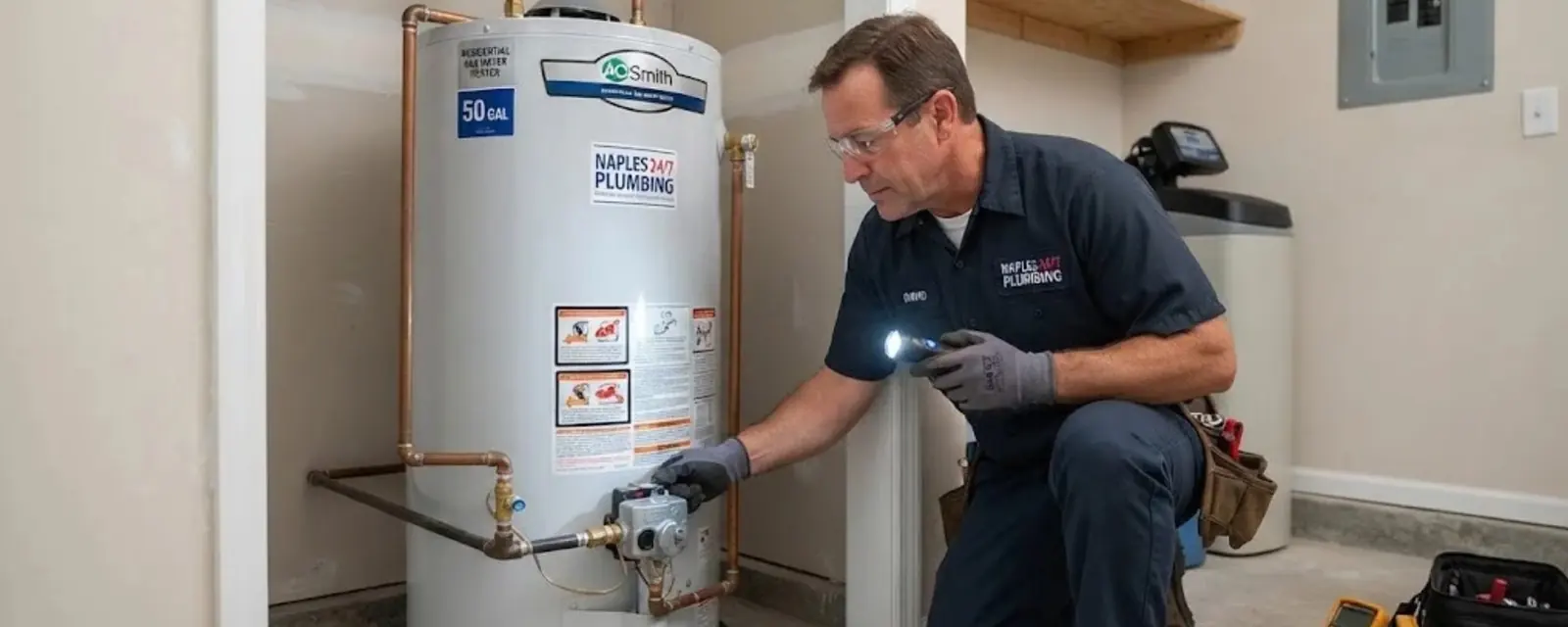
A pool of water around the tank or a shower that runs cold after two minutes is not a problem to sleep on. For water heater repair in Chesterfield, MO, call the 24/7 line and we book the earliest visit we can, same day when available. While you wait, close the cold water valve on the pipe above the tank, switch off the breaker or turn the gas control to off, and keep everyone away from standing water near outlets.
Most failed heaters fail in one of a few ways. Knowing which one you have decides whether a repair is worth paying for, so this page walks through the symptoms, the leak sources, the fuel types and the point where replacing the unit is the better call.
What your water heater is telling you
Homeowners usually describe the symptom, not the part. These are the patterns we hear most, and the first thing each one points to.
No hot water at all
On electric units this is often a tripped breaker, a failed upper heating element or a tripped high-limit switch. On gas units it is more often a pilot that went out or a worn thermocouple.
Hot for a few minutes, then cold
A failed lower element on an electric tank, or a heavy layer of sediment on the bottom of any tank, leaves only the top third of the tank heated.
Lukewarm water that never gets hot
A thermostat set too low is the free fix. A mixing valve problem or a dip tube that has broken down and sends cold water straight to the outlet are the paid ones.
Rumbling, popping or knocking
Water trapped under hardened sediment boils and bursts through it. The noise is a warning that the tank is working harder and wearing out faster.
Rust colored hot water
If only the hot side runs brown, the tank lining or the anode rod is the likely source. If both sides do, the cause is upstream in the pipes.
Water on the floor
This is the one that cannot wait. The source matters, and the next sections show how to tell a harmless drip from a tank that is finished.
When a leaking water heater is an emergency
A tank that is leaking from the body or the bottom seam is failing from the inside, and the leak will grow. A fitting that weeps a few drops is a smaller job. If you cannot tell which you have and the floor is wet, treat it as the first kind and call the 24/7 line.
Water and a gas burner or a 240 volt element do not mix. If the floor around an electric heater is flooded, stay out of the water and shut off power only if the panel is dry and you can reach it safely. If you smell gas at any point, leave the house and call the gas utility or 911 before you call us.
- 1Close the cold supplyThe shutoff sits on the pipe entering the top of the tank. Turn the handle fully clockwise. If it will not move, close the main water valve instead.
- 2Cut the fuelTurn the breaker off for an electric unit, or set the gas control to off for a gas unit. Never leave a heating element powered on a tank that is losing water.
- 3Drain the pressureOpen a hot tap at the highest fixture in the house so the tank stops pushing water out of the leak.
- 4Contain the waterMove stored boxes, lay towels, and run a hose from the drain valve to a floor drain if you have one and the tank is cool.
Where the water around your heater is really coming from
The leak is the largest reason people call about water heaters, and the repair depends on the exact source. This is how we sort a leak into repairable and not repairable.
| Where the water shows up | Likely source | Repairable? | What happens next |
|---|---|---|---|
| Dripping from the inlet or outlet pipes on top | Loose or corroded fitting, failed dielectric union, or flex connector | Usually yes | Replace the fitting or connector, retest under pressure |
| Steady flow from the pipe running down the side or to the floor | Temperature and pressure relief valve discharging | Yes, but find out why | Test the valve, then check water pressure and whether an expansion tank is missing or waterlogged |
| Seeping from the drain valve at the bottom | Worn drain valve washer or cracked plastic valve | Yes | Replace the valve with a brass one and flush the tank while it is open |
| Water pooling under the body, wet insulation, rust streaks | Tank wall or seam has corroded through | No | The tank cannot be patched, so the options are in the replacement page linked below |
| Dampness on a gas or heat pump unit with no drips from pipes | Condensation or a clogged condensate line | Often | Clear the condensate drain, check the flue and the air filter on a heat pump model |
| Water at the base of an electric unit with a front panel | Leaking element gasket | Yes | Drain the tank, replace the element and gasket |
A wet floor can also come from a supply line near the heater and not the heater itself. A paper towel pressed against each joint after the area is dried tells you more than looking.
No hot water this morning?
Tell us the fuel type and what the unit is doing. That narrows the failed part fast.
Electric, gas and hybrid heaters fail in different ways
An electric tank has two heating elements and two thermostats, and nearly every no-hot-water call comes back to one of them. We test each element for resistance with a multimeter and check the upper thermostat and the red reset button before condemning anything. An element is an inexpensive part, so this repair almost always makes sense on a tank that is otherwise sound.
A gas tank depends on a pilot or an igniter, a thermocouple or flame sensor, a gas control valve and a clear flue. A pilot that keeps blowing out points to a thermocouple that is worn or a draft problem in the vent. A burner that lights and shuts off points to a sensor. The gas control valve is the costly part, and on an older tank it can cost enough that replacement is the honest answer.
A hybrid or heat pump water heater adds a compressor, a fan, an air filter and a condensate drain on top of an electric tank. Many fault codes on these units trace to a blocked filter or a clogged condensate line, both of which are simple. A failed compressor or sealed system is another matter, because the repair can approach the price of a new unit, so we explain that before any work.
How we find the failure before quoting the fix
Safe shutdown and listening
We close the supply, secure the fuel and listen for rumbling, hissing or dripping. Sound often separates a sediment problem from a leaking fitting.
Dry and trace
We dry the unit and the floor, then watch where the first drop forms. Water travels along pipes and insulation, so the wettest spot is rarely the source.
Test the parts
A multimeter checks elements and thermostats on electric units. A manometer or draft test checks gas combustion and venting. A pressure gauge on a hose bib checks whether street pressure is high enough to trip the relief valve.
Check the tank itself
We look at the age on the data plate, the condition of the anode rod if it is accessible, and the sediment that comes out when a little water is drawn from the drain valve.
Explain the options
You hear the cause, the repair, what it costs, and whether replacement is wiser. The price is clear before we start work.
What Chesterfield water does to a tank
Missouri American Water supplies most of St. Louis County. In its 2021 St. Louis region water quality report, hardness at the Missouri River plants ran from 76 to 170 mg/L as calcium carbonate, about 4.4 to 9.9 grains per gallon. Meramec River plants ran 66 to 148 mg/L, about 3.9 to 8.7 grains. That is moderately hard water, and heating drops the minerals out as scale.
In practice that scale settles on the tank bottom, insulates the burner or coats electric elements until they burn out. It is the reason a yearly flush helps and why the anode rod deserves a look every few years. Ask Missouri American Water for its latest report and which plant serves your address, or add a water softener or filter if scale is a repeat problem.
Repair it or replace it
Repair is the right call more often than people expect. The decision rests on the part that failed, the age of the tank and whether the tank itself is sound.
Repair makes sense when
- A heating element, thermostat, thermocouple or relief valve is the failed part
- The tank is in its first decade and shows no rust at the seams
- The leak is at a fitting, valve or connector and not the tank wall
- The anode rod can still be reached and is not fully consumed
- The repair costs well under half the price of a new unit
Replacement makes sense when
- Water is coming from the tank body or the bottom seam
- The tank is well past ten years and has had a repair already
- The gas control valve or a heat pump compressor has failed on an older unit
- Sediment is so heavy the drain valve clogs and the flush fails
- Rust is visible at the base and the floor has been wet more than once
What drives the price of a water heater repair
We do not post one number because the range between a reset and a gas valve is wide. The price comes from these factors, and you hear the total before work begins.
Homeowners insurance commonly covers sudden accidental water damage, such as a tank that bursts, but not the heater itself when it wears out. Read your policy and photograph the area before cleanup.
Want the real number for your job? Call the 24/7 line, describe the work, and hear a clear price before anything starts.
Where repair stops and what we will not do
If the tank wall is leaking, no sealant or patch will hold, and we will tell you that instead of selling a part. When a heater is nearing the end of its life, a repair can buy a few months but not much more, and a failed tank often takes the floor with it. The replacement page, water heater replacement, covers sizing and what the swap involves.
We also do not tune gas appliances that show signs of backdrafting or soot, because those need venting corrected, not adjusted. If you want to move the unit or change fuel, that is an installation job, covered under water heater installation. A heater serving homes in towns like Ballwin gets the same diagnosis as one in Chesterfield.
Questions about water heater repair in Chesterfield
Yes. The 24/7 line is staffed around the clock, and we book same-day visits when the schedule allows. While you wait, close the cold supply valve and shut off power or gas to the unit.
Top leaks are usually the inlet and outlet fittings, a flex connector or the relief valve discharge. These are repairable, unlike a leak from the tank body, so a quick check of the joints is worthwhile.
If the heater is working, a failed mixing valve, a crossed line or a closed shutoff is more likely than the tank. Tell us which fixtures are affected so we can start at the right place.
Light ticking as it heats is normal. Rumbling or popping usually means sediment on the bottom of the tank, and the flush described above often quiets it if the tank is not too far gone.
Draining a few gallons or flushing the tank once a year removes loose sediment, which matters with the hardness levels in the 2021 Missouri American Water report. Our service visit includes a flush and a check of the valves and venting.
Often yes, especially for clogged filters, condensate drains and fan issues. A failed compressor is less often worth repairing on an older unit, and we explain the numbers first.
If you smell gas, do not try. Leave the house and call the gas utility. If no gas smell is present and the manufacturer's label shows the steps, relighting once is fine, but a pilot that keeps going out needs a technician.
No. A supply pipe that fails near the heater floods much faster and needs the main shut off. See burst pipe repair if water is spraying and not dripping.
Reference points for this page: The Uniform Plumbing Code (UPC) and the International Plumbing Code (IPC) are the model codes most U.S. jurisdictions adopt, and the local permitting authority decides which edition and amendments apply. Water hardness figures come from Missouri American Water and its 2021 water quality report for the St. Louis region.