
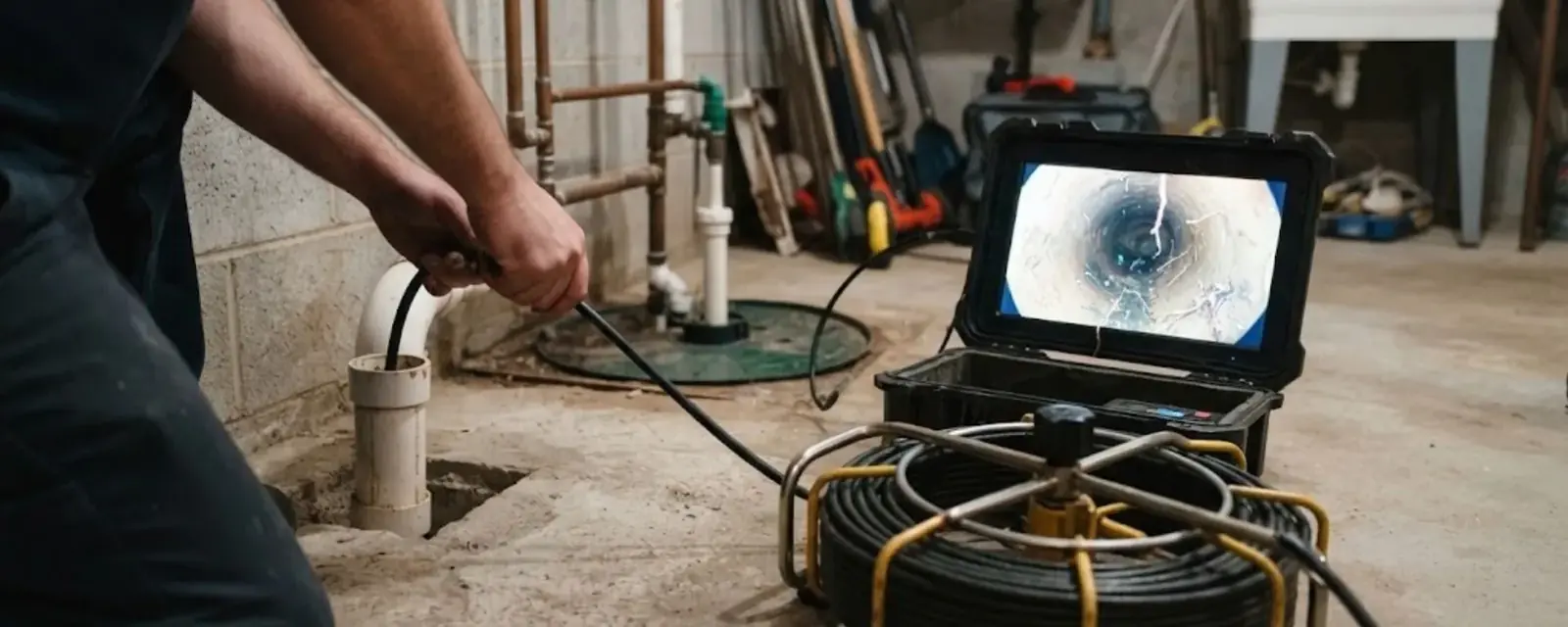
A sewer line is buried, so most of what happens inside it is guesswork until a camera goes in. A sewer inspection in Chesterfield, MO sends a small waterproof camera down the line from a cleanout and shows the pipe wall on a monitor. You see roots, cracks, scale, joints and low spots as they actually are. It is the most direct way to answer whether a repeat backup is a dirty pipe or a damaged one.
Do you have a camera? What the work actually involves
Callers often ask first whether we have the equipment. The honest answer is to describe the work. A pipe inspection uses a camera head on a flexible push rod, with a light, a cable reel and a monitor. A transmitter in the head lets a locator on the surface mark the exact spot and read the depth.
We do not name a brand because the brand is not what matters. What matters is a clear picture, a way to record it and an operator who can explain it. If your line is blocked, we clear it enough for the lens to see. If the pipe is full of water or sludge, we say what the camera cannot show.
What the camera shows, and what each finding means
The picture is only useful once somebody reads it. These are the findings we see most, with the usual consequence for the line.
| What appears on screen | What it means | What usually follows |
|---|---|---|
| Fine white or brown roots at a joint | A small opening where moisture escapes | Cut the roots and plan a spot repair or lining |
| Dark, rough wall with flaking material | Scale or corrosion in cast iron | Cleaning, then repair or section replacement if the wall is thin |
| A pool of water along part of the run | A belly, a dip where the pipe has settled | Monitor if minor, or dig and regrade if it collects solids |
| A ledge at a joint | An offset where two pipes have shifted | Spot repair or, for slight offsets, cleaning and watching |
| A split along the pipe length | A crack or break in clay or plastic | Repair or lining, depending on length and shape |
| Smooth, clean pipe with steady flow | A line in good shape | No repair needed, and the clog may be a fixture issue |
How a camera visit goes from cleanout to answer
Find the way in
A cleanout in the yard, basement or crawlspace is the usual entry. Without one, the camera can go in through a removed toilet.
Clear the lens
If the line is blocked or heavily coated, it is cleaned enough to see. A camera pushed into a pipe full of sludge shows nothing but sludge.
Feed the camera down the line
The operator watches the monitor, notes the footage count and stops at anything unusual. The head is pulled back slowly to get a second look.
Mark the problem on the ground
The locator above the camera head finds the exact spot on the surface and reads the depth. This tells us what a dig would involve.
Explain what we see
We talk through the footage with you in plain words. If we spot damage, we name the likely repair. If we do not, we tell you that too.
Buying or worried about an old line?
A sewer camera records the pipe from the cleanout so you can see what we see.
When a sewer inspection is worth booking
Before you buy a house
Lines are out of sight and the seller may not know their condition. Footage lets you ask for repairs or a price change before closing.
After repeat backups
Two clogs in a year is a pattern. A camera tells you whether the line needs repair or the problem is something you can change.
Before big landscaping or tree planting
Knowing where the line runs and how deep helps you place trees and patios away from it.
When a cable keeps stopping
A machine halting at the same distance means something is there. The camera shows whether it is a root mass, a joint or a collapse.
After a repair
A second camera pass confirms the new section is joined cleanly and the old line downstream is sound.
What a camera can and cannot tell you
A camera inspection is a visual check, not a guarantee. It shows the pipe wall as it is on the day of the visit.
What it can show
- Roots, cracks, scale, grease and foreign objects
- Offsets, bellies and joint condition
- The footage distance to each problem
- The surface location and depth with a locator
What it cannot show
- Hairline cracks hidden under heavy scale or water
- How the line will behave in the next heavy rain or root season
- What lies beyond a full collapse or blockage
- Exactly where your lateral meets the public main at the street
What you get after the camera comes out
We explain what we saw, mark the locations and say whether the line needs sewer line cleaning, repair or nothing. If the footage shows damage, the next page in the process is sewer line repair, where spot repair, lining and replacement are laid out.
We keep this honest. A sound line gets a sound report, even though that means no repair sale. For buyers in nearby towns like Town and Country, footage of a clear, flowing line is a useful thing to hold.
What affects the cost of a sewer camera inspection
A camera visit is priced from the access and the length of the line. We give the price before work starts. These factors drive it.
Insurance note: a camera inspection is a diagnostic cost, and homeowners policies often do not reimburse it. Some pay for it only as part of a covered sudden-damage claim, so ask your insurer first.
Want the real number for your job? Call the 24/7 line, describe the work, and hear a clear price before anything starts.
Footage and the City's lateral repair program
The City of Chesterfield says the property owner is responsible for the lateral sewer service line. The City's Residential Sanitary Sewer Lateral Repair Program can cover certain repairs up to $15,000, but only after the line has been cabled by a licensed plumbing company or licensed drainlayer and it did not clear.
A camera inspection is not the same as the cabling the program asks for, so keep the cabling invoice. Footage can still help you explain where the problem sits. Ask the City's Department of Public Works whether your repair qualifies before you spend money.
Questions about sewer camera inspection in Chesterfield
Yes, camera work is part of our drain and sewer visits. It means a push-rod camera, a monitor, a locator and a recording, and we explain what shows on screen.
Usually yes. The footage gives a distance, and a locator marks the spot on the ground and reads its depth.
It is a sensible step for an older house or one with trees near the line. It shows the pipe condition before you close.
Often. A pipe full of sludge or water blocks the lens, so we clear it enough to see.
There is no fixed interval. Do it after repeat backups, before buying a home or when the cable keeps stopping short.
Usually, through a removed toilet. We may suggest installing a cleanout to make future work easier.
Reference points for this page: The Uniform Plumbing Code (UPC) and the International Plumbing Code (IPC) are the model codes most U.S. jurisdictions adopt, and the local permitting authority decides which edition and amendments apply. Sewer lateral ownership and the repair program are described by the City of Chesterfield.