
A damp stripe along the base of a basement wall, a musty smell after rain, or a puddle by the floor drain all point to the same question: where is the water coming from? Basement waterproofing in Chesterfield, MO starts with answering that, because the fix for a cracked wall is nothing like the fix for a clogged downspout.
Our plumbers work on the parts that involve pipe, pits and pumps. That covers interior drain tile that discharges to a sump, the sump pit itself, floor drains and sealing at pipe penetrations. We also tell you honestly when the job belongs to a foundation or waterproofing contractor.
Check these before paying anyone to dig
Many wet basements get better with simple fixes outside the house. Work through this list after the next hard rain.
- ✓GuttersLook for overflowing or clogged gutters during rain. Water spilling at the roof edge lands right beside the foundation.
- ✓Downspout endsExtensions should carry water several feet away from the wall, not drop it at the corner.
- ✓Soil slopeSoil near the house should fall away from it. A dip or a sunken planting bed holds water against the wall.
- ✓Window wellsLeaves in a well with no drain fill like a bathtub. Clear them and check for a drain at the bottom.
- ✓Where the water shows upMid-wall wetness, a floor-wall joint line or a rising spot in the center each suggest a different cause.
Where the water enters and who fixes it
Waterproofing is a team sport. This table shows who normally owns each cause so you do not hire the wrong trade first.
| Entry point | Typical sign | Fix | Usually handled by |
|---|---|---|---|
| Clogged gutters or short downspouts | Wet wall below the gutter line after rain | Clean, extend or re-route roof water | Homeowner, roofer or gutter installer |
| Water rising at the floor-wall joint | Damp line along the base of walls | Interior drain tile to a sump | Waterproofing contractor, plumber for pit and pump |
| Full or failed sump pit | Pit overflows or the pump cannot keep up | Replace or upsize pump, add backup | Plumber |
| Floor drain backing up | Gray water or smell at the drain | Clear or camera the line, check the backwater valve | Plumber |
| Cracked or bowed wall | Horizontal crack, stair-step crack or wall movement | Structural repair and exterior membrane | Foundation contractor |
| Leaky pipe or fixture | Wet spot that is not tied to rain | Locate and repair the leak | Plumber |
Not every wet basement is a waterproofing problem. A supply or drain leak can look the same until you check the water meter or run the fixtures.
What interior drain tile and a sump actually do
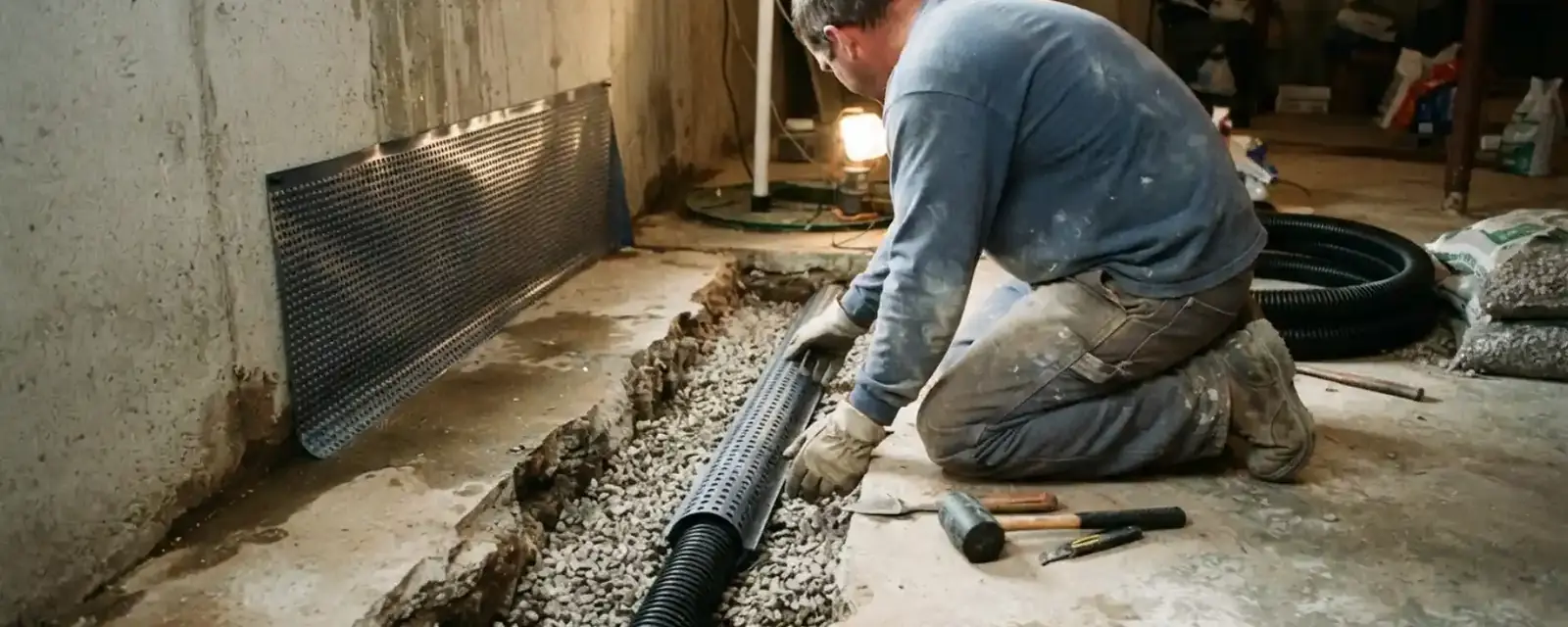
Interior drain tile is a perforated pipe laid in a trench along the inside edge of the footing, covered in gravel, with the floor patched over it. It does not stop water from reaching the wall. It gives that water an easy path to a sump pit, where a pump lifts it out and away.
That is why the pump matters as much as the pipe. A system with new drain tile and a tired pump just moves the flood a few feet. We install and service the pit, pump, check valve and discharge, and for the pump side see our page on sump pump repair and backup.
Damp walls or a wet floor line?
Where the water enters decides whether the fix is drainage, a pump or sealing.
How a plumber diagnoses a wet basement
Ask when it happens
Water only after heavy rain points outside. Water in dry weather points to a pipe, a high water table or a leaking fixture.
Check the plumbing first
We watch the water meter with every fixture off and look at supply lines, the water heater and the laundry hookups. A moving meter means a leak, not groundwater.
Look at the drains
A camera or a drain machine tells us whether a floor drain is blocked or whether the main line is backing up.
Inspect the pit and pump
If a pit exists, we test the float, the check valve and the discharge. Many wet basements trace back to a pump that was never sized right.
Walk the outside
We note gutters, grading and window wells and tell you which cheap outdoor fixes to try first.
Give you a straight answer
If the cause is structural or needs exterior excavation, we say so and do not sell you an interior system that will not solve it.
Signs that point to a waterproofing problem rather than a leak
Chalky white deposits on concrete
Efflorescence is the salts left behind when moisture moves through masonry. It means the wall is wet from the outside in.
Musty smell that peaks after storms
Humidity from damp walls and floor, especially in a closed room, often shows up first as odor.
Peeling paint or bubbled floor coverings
Moisture pushing up behind a surface rather than a drip from above.
Dampness at one corner
A single corner often points to a downspout, a window well or a sloped yard feeding that spot.
Water seeping where a pipe enters the wall
Gaps around sewer, water and gas penetrations can leak and are within the plumbing scope to seal.
Creeks, the Valley and what they mean for a Chesterfield basement
Caulks Creek and Bonhomme Creek both flow into the Missouri River within Chesterfield, and Chesterfield Valley is low Missouri River floodplain. Properties on low ground or beside a creek corridor can see groundwater and surface runoff behave differently than a house on a ridge.
That does not mean every basement here is wet. It means the lowest floor of a building near a creek or in the Valley deserves a working pit, a well-sized pump and a tested backup before storm season. Whether a given address needs one is something we judge on site, not from a map.
What shapes the cost of basement waterproofing work
Prices differ widely because the scope differs widely. We give a clear price before work starts and tell you which parts of the job we handle.
Homeowners policies commonly cover sudden accidental damage but exclude seepage and groundwater, and flood damage needs separate flood insurance. Check your policy before assuming a waterproofing job is covered.
Want the real number for your job? Call the 24/7 line, describe the work, and hear a clear price before anything starts.
What we do and what belongs to another trade
Plumbers handle
- Sump pit, pump, check valve and battery backup
- Interior drain tile that ties into a sump
- Floor drains, backwater valves and drain line cameras
- Leaks from supply lines, fixtures and water heaters
- Sealing around pipe penetrations
Foundation or waterproofing contractors handle
- Cracked, bowed or shifting foundation walls
- Exterior excavation and wall membranes
- Large regrading or retaining walls
- Concrete floor replacement over large areas
- Mold remediation after long moisture exposure
When waterproofing is not the right fix
If a basement gets wet only a couple of times a decade, a good sump pump and a regraded yard may be all it ever needs. Spending on full interior tile would be money wasted. A leaking pipe, a failed water heater or a backed-up floor drain can also look like groundwater, and no drain tile will cure those.
If the floor drain gurgles or backs up, the cause is usually in the sewer line, so we start with drain cleaning or a sewer camera inspection. If you are comparing us with a waterproofing contractor, ask each what they will not cover. For nearby addresses, see how we serve Ballwin homes too.
Questions about basement waterproofing in Chesterfield
A plumber can handle the interior drainage side, meaning drain tile to a sump, the pit, the pump and floor drains. Cracked walls and exterior membranes belong to a foundation or waterproofing contractor.
A leaking pipe, a fixture or a high water table can all do it. Watch the water meter with everything off, and call if the dial keeps moving.
Only if water is reaching a pit that already collects it. If water seeps through walls or the floor joint, you may also need interior drain tile or exterior work.
Yes. Roof water and soil that slopes toward the house are among the most common causes, and fixing them is often the cheapest step.
Usually not. Policies commonly cover sudden accidental damage but exclude seepage, groundwater and flood. Check your policy or ask your agent.
The Valley is low Missouri River floodplain, so groundwater and runoff are worth checking at the lowest floor. We judge each building on site rather than assuming.
Reference points for this page: The Uniform Plumbing Code (UPC) and the International Plumbing Code (IPC) are the model codes most U.S. jurisdictions adopt, and the local permitting authority decides which edition and amendments apply.