
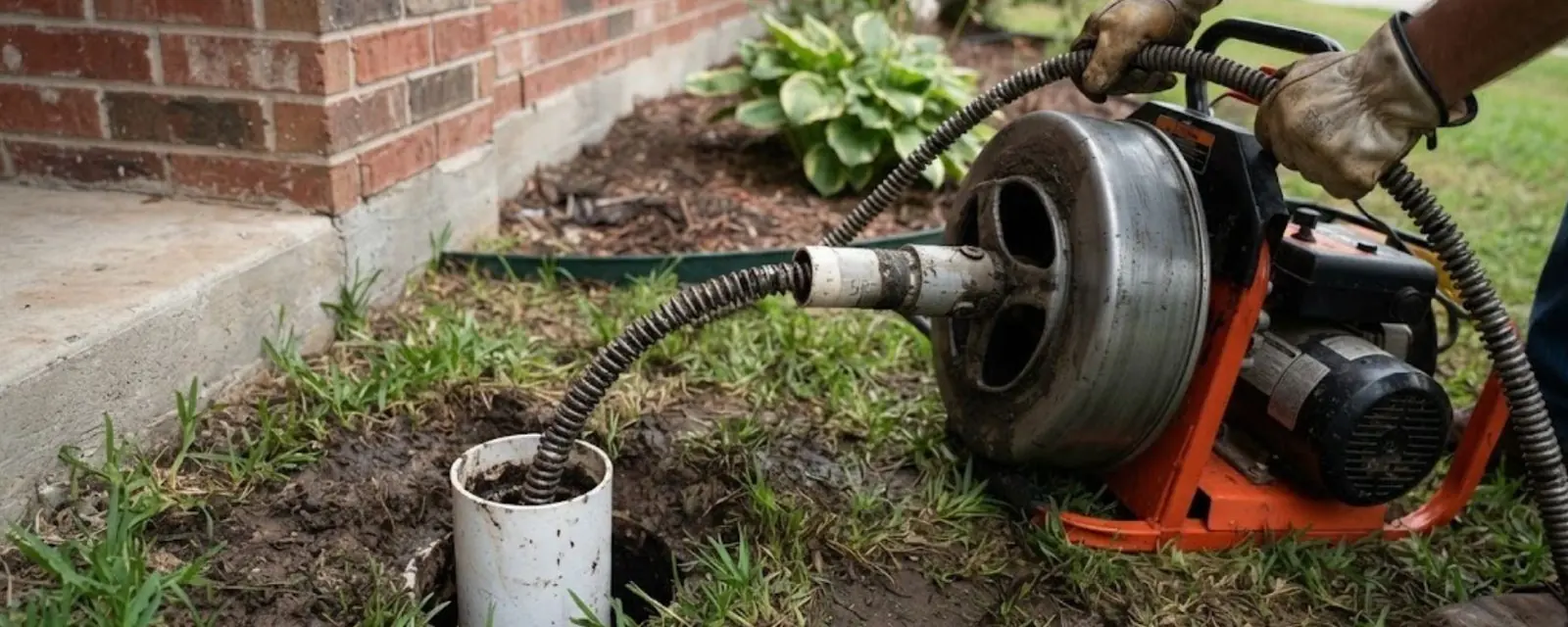
Cleaning underground gutter drains in Chesterfield, MO starts with finding where the pipe goes. A buried downspout line carries roof water from the gutters to a pop-up emitter, a curb outlet, a dry well, a sump pit or a storm connection. If any of those is blocked, water backs up at the downspout and spills against the foundation.
You can often flush a line yourself with a garden hose. The catch is knowing where it ends, because forcing water or debris into the wrong place causes bigger trouble.
Signs the buried line is blocked
Water overflows at the downspout top
The gutter fills, spills over the edge and soaks the same spot in the yard during every storm.
Pooling around the pop-up emitter
Water bubbles out of the ground near the downspout instead of flowing to the end of the line.
Gurgling or slow drain after rain
A line that is partly plugged makes noise and takes hours to empty.
Damp basement wall below a downspout
Roof water that cannot leave the line seeps along the foundation.
A soft or sunken strip in the lawn
Soil washes out along a cracked or collapsed pipe.
Find the line before you flush it
Walk the downspouts
Look at each downspout base. A pipe that dives into the ground, a grate or a rubber elbow means it connects to a buried line.
Look for cleanouts
Cleanouts are short capped pipes at or just above grade, often white or black plastic with a threaded cap. Some are set in a small box in the lawn.
Follow the path to the outlet
Walk downhill from the downspouts. Look for a pop-up emitter, a curb opening, a swale or a drain grate.
Mark what you find
Spray paint or flags help you remember the line. Take photos of any outlet before flushing.
Listen and test
Pour a bucket of water into the downspout and see how fast it appears at the outlet. A long delay points to a blockage.
Where the buried drain ends and what that changes
The destination decides how you clean it and how much water you can send down it.
| Where the line ends | What it means | Careful with |
|---|---|---|
| Pop-up emitter in the yard | Water spills out on the surface a few feet away | Clogged emitter caps and root intrusion |
| Curb or street outlet | Roof water goes to the street drainage | Debris pushed to a public outlet |
| Dry well or gravel pit | Water soaks into the ground | Silted pit that no longer drains |
| Tie-in to the sump pit | Roof water adds to the pump workload | Flooding the pit and running the pump too hard |
| Storm sewer connection | Water enters a storm system | Rules on connections and flushing |
| Sanitary sewer connection | Roof water enters the wastewater system | Do not flush, call a plumber |
Roof drains should not be tied into the sanitary sewer. If you suspect they are, ask the City's Department of Public Works what applies before you change anything.
Downspout lines overflowing?
Buried drains clog with roots and silt, and a camera shows which.
Flushing the line with a hose
Start at the cleanout or the downspout. Pull the pop-up emitter cap off at the far end so debris has a place to leave. Put the hose into the pipe and run water with the hose moving forward and back.
Mud, leaves, shingle grit and small roots wash out with steady flow. A pressure nozzle helps, but keep it from shooting debris back toward the house. If water backs up at the cleanout, stop and let it drain before trying again.
A drain snake or a small drain machine can clear the pipe when flow alone does not. Be gentle, since a hard push can tear a flexible corrugated pipe. If a snake stops at the same point twice, you have probably hit a crushed section or a root mass.
Safety and common mistakes with buried downspout lines
- ✓Call 811 before digging anywhere along the line, since gas and electric lines may run nearby.
- ✓Never push a pressure washer wand deep into corrugated pipe, because the ribs can tear or fold.
- ✓Do not flush a line that you suspect ties into the house drain. Water and debris could back up inside.
- ✓Keep the hose running while you pull the nozzle back so loosened debris moves out.
- ✓Wear gloves and eye protection, since old lines hold mud, insects and sharp shingle grit.
- ✓Stop if water rises quickly at the cleanout and let the line drain before you start again.
Where Chesterfield stormwater goes and who to ask
Caulks Creek and Bonhomme Creek flow into the Missouri River within Chesterfield, and the river forms the north edge of the city. That is the general water story of the area. That general picture cannot tell you where the buried drain at your address ends.
So before you tie a downspout into a new line or push debris toward an outlet, ask the City's Department of Public Works what connections are allowed and where public outlets are. Permit rules vary, so ask the City or St. Louis County before work that may need a permit.
Source types: Wikipedia summary of city data, city website.
Hose flushing versus a drain machine or jetter
Both clear buried lines. They differ in force and risk.
Hose flush
- Free and gentle on old pipe
- Good for leaves and loose mud
- Needs a clear outlet
- Does not cut roots or hard buildup
- Fine as a yearly routine
Machine or jetter
- Cuts through roots and packed silt
- Reveals line damage when paired with a camera
- Needs a trained hand and safe access
- Can damage thin or collapsed pipe
- Better after repeated backups
What makes buried drain cleaning cost more or less
The price follows access and what is in the pipe.
Homeowners policies typically cover sudden accidental water damage but not slow drainage failure or lack of maintenance. Check your policy before filing.
Want the real number for your job? Call the 24/7 line, describe the work, and hear a clear price before anything starts.
When to call a plumber
If the hose flush fails, a plumber can run a machine or a jetter. Our drain cleaning work covers buried downspout lines and yard drains, and hydro jetting clears packed silt and roots when a snake will not. A camera run shows whether the pipe has collapsed or whether a different repair is needed.
We also serve nearby towns, including Ballwin and Town and Country. If water is pouring against the foundation or into the basement, call the 24/7 line.
Questions readers ask
Follow the downspout into the ground, look for capped cleanouts and walk downhill toward a pop-up emitter, a curb opening or a drain grate.
Yes, if you know where it ends. Remove the emitter cap at the outlet so debris can leave, then flush from the cleanout or the downspout.
Heavy roof flow can overload the pump. Flush slowly and watch the pit, and ask a plumber if the pump runs nonstop after rain.
Once a year is common, with extra attention after storms or when trees drop leaves into the gutter. Clean gutters first so less debris reaches the line.
Ask the City's Department of Public Works before connecting or changing a roof drain line. Caulks Creek and Bonhomme Creek flow into the Missouri River, but the route at your address depends on the lot.
Reference points for this guide: The Uniform Plumbing Code (UPC) and the International Plumbing Code (IPC) are the model codes most U.S. jurisdictions adopt, and the local permitting authority decides which edition and amendments apply. This guide is general information and does not replace a visit.