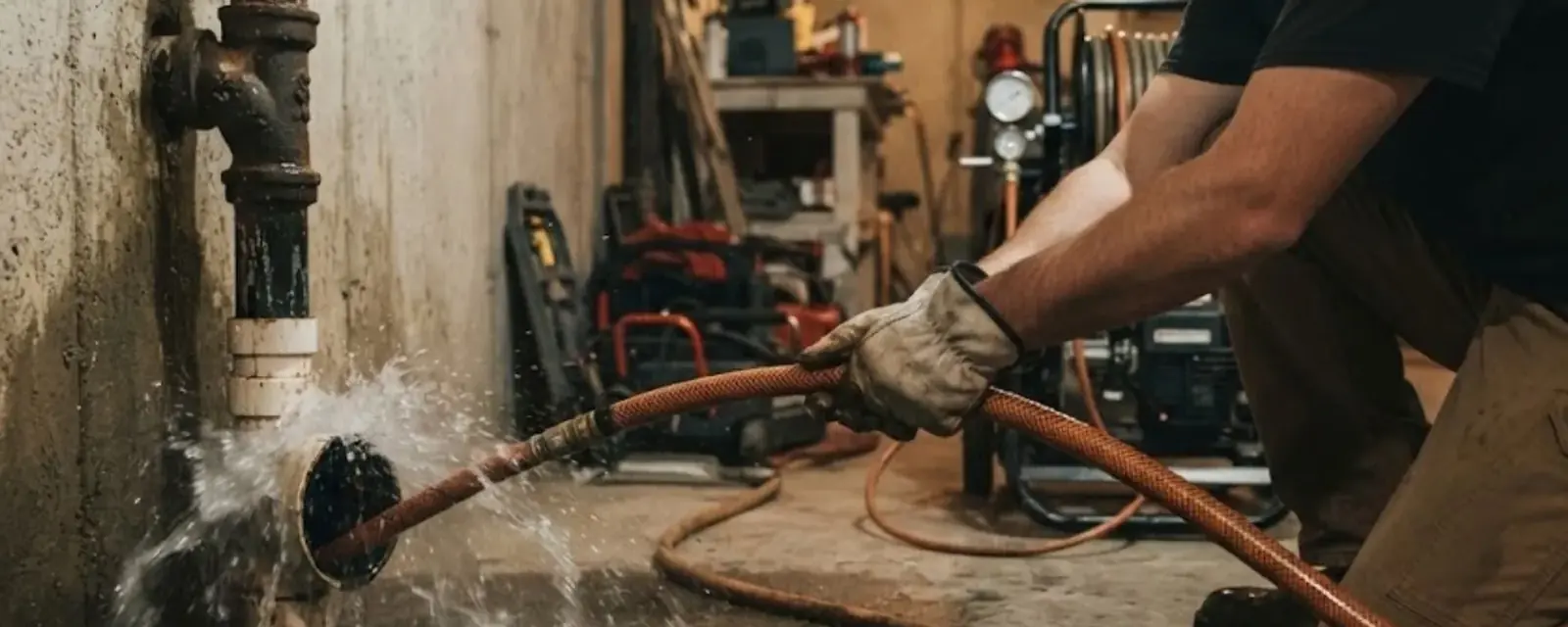
The line was snaked, the water ran for a few weeks, and now the same drain is slow again. Or the cable stopped 60 feet down and nobody could say why. These are the cases where hydro jetting in Chesterfield, MO usually comes up. A jetter pushes high-pressure water through a hose to scour the pipe wall. Our 24/7 line takes these calls. While you wait, stop using water and note which drains are affected.
Signs that a cable alone is not enough
A cable is the right tool for a hairball or a stuck toy. These patterns suggest something coating or filling the pipe instead.
Clogs return within weeks
The drain clears, then slows again in a month or two. A cable leaves a narrow channel, and grease or scale rebuilds around it.
The cable stops far down the line
A machine that halts at the same distance every time has hit roots, a bad joint or a collapsed section. Pushing harder can wedge it.
Roots come back on the cutter
Fine hair-like roots wrapped on a cutting head mean the line has a small opening somewhere. Cutting them clears flow but they regrow.
Greasy, gray sludge
Kitchen lines and laundry lines coat with fat and soap. The sludge looks like candle wax on the cable when it is pulled out.
Slow drainage everywhere
When every fixture drains at half speed rather than one failing outright, the main line is narrowed along its length.
Why a camera look often comes before the jetter
High-pressure water is only as good as the pipe it runs through. A sound cast iron or PVC line takes it well. A cracked clay tile, a pipe with a belly that holds water, or a joint that is already open can be made worse by a strong jet. So we want to know what we are cleaning.
A pipe camera on a flexible rod shows the wall, the roots and any offset joint, and it records the footage. It usually takes one extra step on the visit. If the picture shows a damaged line, we explain that and move toward sewer line repair instead of washing it. If the line is sound but coated, jetting becomes a safe next move.
For lines with no known history, that camera pass is the cheapest insurance against an expensive mistake. A full look is described on our sewer inspection page.
How a jetting visit runs on site
Open an access point
The hose enters through a cleanout, or through a removed toilet if no cleanout exists. A clean outdoor cleanout is the best option.
Start with a pilot pass
A small nozzle is fed in at low pressure to learn where the line bends and where it narrows. This avoids driving the hose into a blockage at full force.
Cut and wash in stages
A forward-facing nozzle bores through the clog. Rear-facing jets then pull the hose back while the water scours the walls and carries debris toward the main.
Work back and forth over the worst runs
Roots and heavy grease take several passes. The pressure is set by the pipe material and the age we can see.
Verify with flow or camera
We run water through the whole branch. If the line has history or the clog was severe, a second camera pass shows the clean wall.
Roots or grease keep coming back?
A camera look first tells us whether jetting is the right answer or a waste of your money.
Hydro jetting versus a drain machine
Hydro jetting
- Scours grease, soap scale and silt from the whole pipe circumference
- Flushes debris down the line so it does not sit behind a cut hole
- Handles long runs and large-diameter mains well
- Needs a sound pipe, good access and a water supply
Cable or drain machine
- Fast and low cost for a single blockage near a fixture
- Gets into tight small-diameter traps and branches
- Cuts through a root mass but leaves the debris in the pipe
- Rarely prevents a repeat clog from grease or scale
Many jobs use both. We often cable first to open a path, then jet to finish. For everyday fixture clogs, the drain cleaning page lays out when a cable is enough.
When hydro jetting is the wrong tool
Jetting is not a cure for every slow line, and we say so when it applies. A strong jet should never go into a pipe we have not looked at.
| Condition | Why jetting is a poor fit | Better step |
|---|---|---|
| Cracked or broken clay or cast iron pipe | Water can open the crack further and wash soil into the pipe | Camera look, then spot repair or lining |
| Separated or offset joint | The jet may escape through the gap and flood the soil | Locate the break and repair the section |
| Bellied section holding water | Jetting cleans it but the dip refills with debris | Plan a replacement of the low section |
| Thin-walled or heavily corroded old pipe | Scale may be holding the wall together | Camera first, gentle cabling if the wall looks weak |
| Blocked by a solid object like a toy or a rag | A jet cannot dissolve it | Cable or retrieve the object |
Jetting also does nothing for a line that is simply too small or sloped wrong for the fixtures it serves. If a camera shows that, the answer is a repair.
When a sewer backup means calling right now
A line packed with roots or grease can fail at any hour, usually when the washer or a shower puts the last gallon in. Sewage in a basement drain or a tub that will not empty after you flush is an emergency, and it should not wait for a normal appointment.
Call the 24/7 line. We take same-day visits and after-hours calls for backups, and the first job is to open the line so the house can drain again. Jetting may follow that same visit or a scheduled one, depending on what the camera finds.
- 1Stop using sinks, showers, toilets and the washer.
- 2Keep floor drains clear of rugs and stored boxes.
- 3Do not pour chemical cleaners into a backed-up drain.
- 4Photograph the water for insurance before any cleanup.
Commercial kitchens and grease lines
Restaurants and other commercial kitchens are the classic jetting customers. Fat from fryers and dish stations hardens inside the waste line, and a cable can pass through the clog while the walls stay lined. Scheduled jetting keeps those lines flowing between visits.
A grease trap is separate from the line it feeds, so trap pumping and line jetting are different jobs. For shop floors, food service and multi-tenant buildings, see commercial plumbing for how those visits are handled.
What shapes the price of hydro jetting
Jetting is priced from the problem, not a flat menu. We quote before work starts, and these are the factors we weigh.
Insurance note: homeowners policies commonly cover sudden accidental damage but not maintenance, and a clog from roots or grease is often treated as maintenance. Check your policy before you call.
Want the real number for your job? Call the 24/7 line, describe the work, and hear a clear price before anything starts.
If the line is the lateral, check the City first
In Chesterfield, the City says the property owner is responsible for the lateral sewer service line from the house to the main. The City's Residential Sanitary Sewer Lateral Repair Program can cover certain lateral repairs up to $15,000, but only after a licensed plumbing company or licensed drainlayer has cabled the line and that did not clear it.
The program's wording is about cabling, so ask the City's Department of Public Works whether a jetting invoice counts before you choose jetting on a lateral. Keep every invoice either way. Homes in Wildwood and other nearby towns may follow different local rules, so ask that city's building department.
Questions about hydro jetting in Chesterfield
Yes. The 24/7 line dispatches for backups and lines that will not drain. We clear the line first, and a full jetting pass can follow once we know the pipe condition.
It depends on the pipe. Sound cast iron and PVC handle it. Cracked, offset or badly corroded pipe may not, which is why we look inside first.
If the cause is grease, scale or roots on a sound pipe, often yes. If a camera shows a crack or a belly, the line needs repair.
It cuts and flushes fine roots and clears the line. The roots return unless the entry point is repaired, so a camera is the way to find that point.
Yes, we handle commercial grease lines and floor drains. Grease trap pumping is a separate service from jetting the line.
A short branch may take a single pass. A long main with a camera pass before and after takes longer, and we explain the time once we see the line.
Reference points for this page: The Uniform Plumbing Code (UPC) and the International Plumbing Code (IPC) are the model codes most U.S. jurisdictions adopt, and the local permitting authority decides which edition and amendments apply. Sewer lateral ownership and the repair program are described by the City of Chesterfield.