
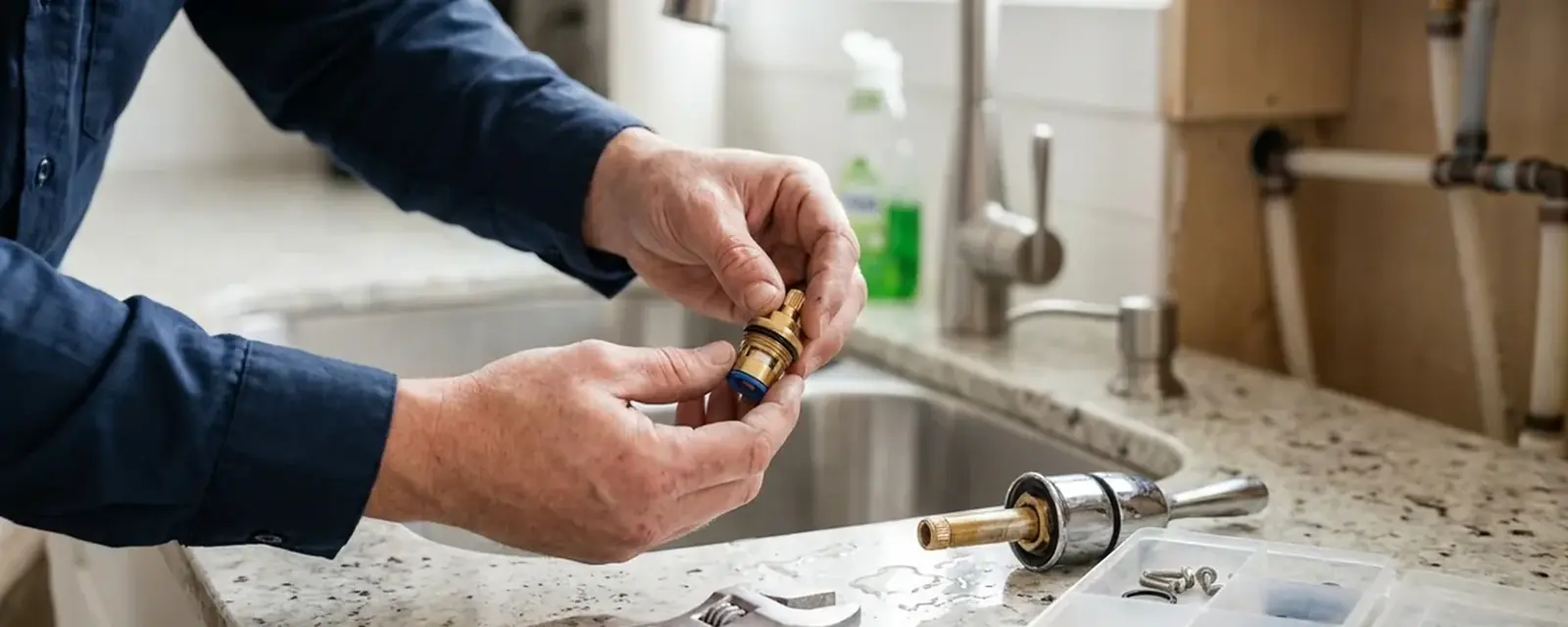
Which is worse, a drip you can hear all night or a valve that will not close when you need it to? In Chesterfield, MO, both bring people to the phone. Faucet and sink repair covers steady drips, handles that spin freely, shower valves that leak behind the wall, and supply lines that fail under a vanity.
If water is spraying or pooling right now, close the angle stop under the sink by turning it clockwise. If that handle will not move, shut the main. Then call the 24/7 line so we can plan the right parts before arriving.
Fixture problems we see most
Different fixtures fail in different ways. Matching the symptom to the fixture saves a wasted trip.
Kitchen faucet drips from the spout
An internal cartridge, washer or seat has worn. The sprayer hose under the sink can also weep and be mistaken for the spout.
Cabinet floor is wet
A cracked supply line, a loose compression nut or a leaking drain trap. A dry paper towel run along each joint shows which one is wet.
Shower head or tub spout keeps dripping
Usually the valve cartridge behind the handle, not the showerhead. A showerhead that only sprays sideways is clogged with mineral scale.
Handle is loose or stiff
Worn stem, corroded cartridge or a set screw that backed out. Sometimes the valve body itself is pitted.
Low flow from one faucet only
Clogged aerator or a partially closed angle stop. If every faucet is low, the issue is the building supply instead.
When a shutoff valve will not close, it is an emergency
The worst fixture failures are the ones where you cannot stop the water. An angle stop that spins without closing, a supply line that has split, or a tub valve that sprays when the handle is off all count. Water at that pressure can empty a vanity into a basement in a few minutes.
We carry replacement stops and braided lines on the truck and can shut the water at the main while we work. Same-day and after-hours calls go through the 24/7 dispatch line, and we explain the repair and price before we cut anything.
- 1Close the main shutoff, usually near the meter or where the line enters the house, and open a lower faucet to drain pressure.
- 2Put a bucket under the leak and towels around the base. Move anything that can stain or warp.
- 3If water is near an outlet, a power strip or an appliance cord, stay clear and cut power only from a dry, reachable panel.
- 4Do not keep forcing a stuck valve handle. A corroded stem can snap and turn a drip into a spray.
- 5Take a quick photo of the fixture and the label on the cabinet wall to help us stock parts.
Cartridge, washer, ceramic disc: how your faucet is built
Knowing the style tells us what wears out and whether repair is worth it. Many homes have more than one type.
Washer (compression) style
- Two handles, each with a rubber washer and seat
- Drip usually means the washer or seat is worn
- Cheap to repair and easy to rebuild
- Stems can seize in hard water scale
Cartridge or disc style
- One lever or two handles with a sealed cartridge
- Drip or stiff handle means replace the cartridge
- Fast swap, but parts are brand specific
- Ceramic discs last long and fail from grit
Dripping, spraying or stuck handle?
Most faucet leaks come down to one worn part, and many are quick repairs.
Shower valves and tub faucets behind the wall
A shower that drips after you turn it off is usually a worn cartridge or seat in the valve. A tub spout that leaks around the wall can be a failed diverter or a loose seal. Most of these are reachable by taking off the handle and trim without opening the tile.
When the valve body itself is corroded, or the leak shows up on the ceiling below, the repair is bigger. We may need an access panel, usually from the back side of the wall, and we will tell you where we need to cut before we cut.
If the wall is damp but you cannot tell where it comes from, a moisture meter and a pressure test on the shower branch separate a valve leak from a pipe leak. Hidden problems may call for leak detection before we open anything.
Drips, clogs and leaks: what to check first
| Where it shows | Likely cause | Try this, or call |
|---|---|---|
| Kitchen sink fills and drains slowly | Food buildup in the trap or branch line | Clear the stopper and trap. If the whole line is slow, call for a drain machine. |
| Tub or shower pools around your ankles | Hair and soap in the strainer and trap | Pull the strainer and remove what you can reach. Persistent slowness needs a cable. |
| Drip at the base of the spout | Worn O-ring or cartridge | Replace the O-ring. If the faucet is old, replace the cartridge. |
| Water under the sink only when running | Loose drain slip nut or cracked tailpiece | Hand tighten the slip nut and retest. A cracked part is a replacement. |
| Utility sink leaks at the wall | Failed supply connection or stripped shutoff | Shut the wall valve. Replacement is usually quick. |
| Hissing from a valve when closed | Worn stem seat | Replace the valve rather than keep tightening it. |
Hard water leaves marks on Chesterfield fixtures
Missouri American Water supplies most of St. Louis County, and its 2021 water quality report listed hardness of 76 to 170 mg/L for Missouri River facilities, roughly 4.4 to 9.9 grains per gallon. That is moderately hard water. In practice it leaves white scale on aerators and showerheads, and stiff handles over time.
Soak a clogged aerator in vinegar for an hour and the flow often returns. Ask Missouri American Water for the latest report and which plant serves your address, since the numbers differ by source.
What happens when we come out for a fixture leak
Stop the water
We close the angle stop, or the main if the stop fails, and soak up what we can so we can see the actual joint.
Trace the drip
Dry each connection, then run the water and watch. A wet line at the valve points to the cartridge, while a wet trap points to the drain side.
Show you the options
We tell you whether a cartridge, a seat or the whole faucet is the smarter fix, and we give you the price before we start.
Repair or replace
We install the part or the new fixture, replace stiff shutoff valves while the area is open and reconnect the drain.
Run it and check
We run hot and cold, check for drips under the sink and leave the area dry.
When a faucet is not worth repairing
We would rather tell you than sell you another part. Replacement usually wins in these cases.
- ✓Pitted or corroded valve body, where a new cartridge cannot make a seal
- ✓Parts that are no longer sold, so the repair is a guess
- ✓Faucet that has already been rebuilt more than once
- ✓Cracked brass or a spout that wobbles at the base
- ✓A fixture you plan to replace for looks within the year
Factors that set the price of fixture work
A drip and a burst supply line are different jobs, and we price what we find rather than a flat call-out guess.
Homeowners policies commonly cover sudden accidental water damage but not a long-running drip, so review your policy if the cabinet or ceiling is wet.
Want the real number for your job? Call the 24/7 line, describe the work, and hear a clear price before anything starts.
A few notes on drains and sink clogs
A slow kitchen or tub drain is often a trap or branch clog and not a fixture fault. Our drain cleaning crews cable out shower and tub lines. For a disposal that jams, see garbage disposal repair. We also repair sinks and fixtures in nearby Ballwin and surrounding towns.
Questions about faucet and sink repair in Chesterfield
Yes. Dispatch runs 24/7 with same-day appointments when available. Close the angle stop under the sink or the main shutoff while you wait.
Shut the main water valve and call us. Do not keep turning a stuck handle, since a corroded stem can break and release full pressure.
If the body is sound and parts are available, a cartridge or washer swap is the cheaper choice. Heavy corrosion or a faucet that has been rebuilt before usually means replacement.
The valve cartridge or seat behind the handle has worn. It is usually fixable from the front of the wall without opening tile.
Usually yes. We check the trap and drain line and the fixture in the same trip, and tell you which one needs a deeper fix.
A clogged aerator is the most common cause, and mineral scale from moderately hard water is a frequent reason. Soak it in vinegar, and call if it persists.
Reference points for this page: The Uniform Plumbing Code (UPC) and the International Plumbing Code (IPC) are the model codes most U.S. jurisdictions adopt, and the local permitting authority decides which edition and amendments apply. Water hardness figures come from Missouri American Water and its 2021 water quality report for the St. Louis region.