
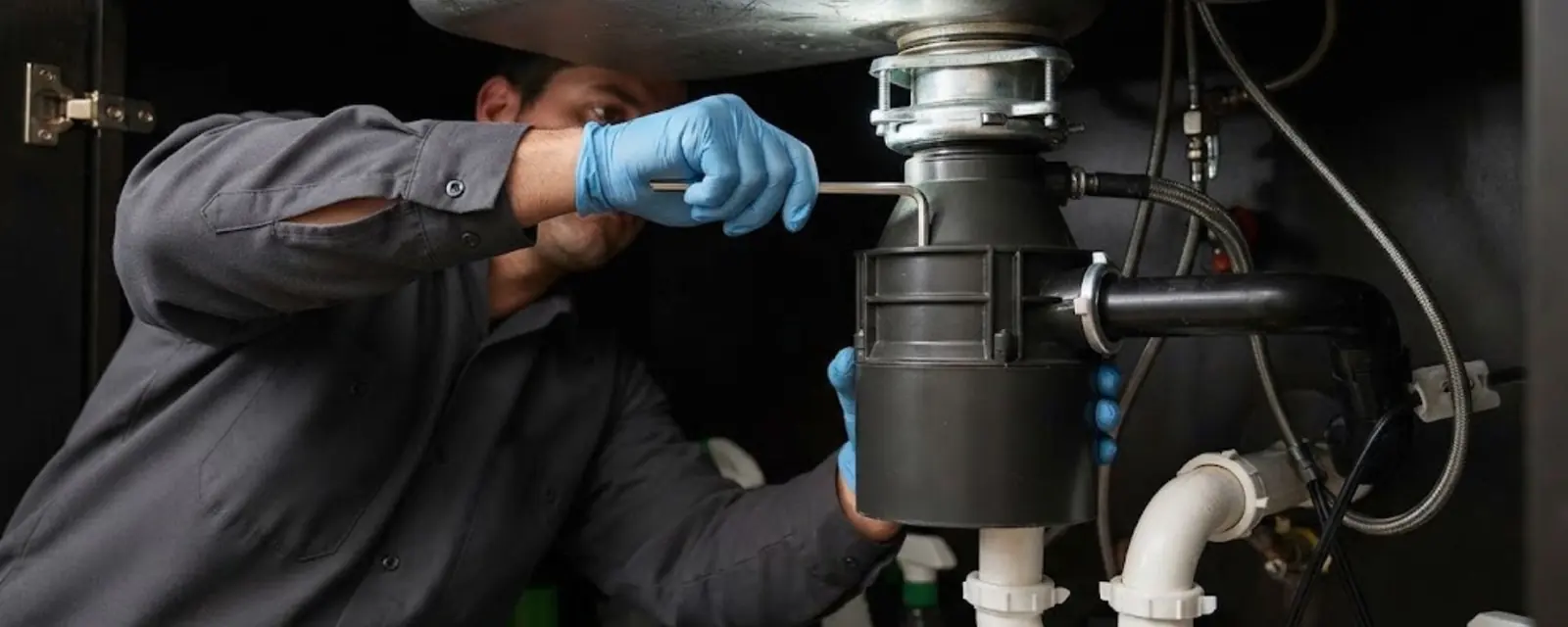
A disposal that hums and will not spin, or leaks onto the cabinet floor, usually shows up at the worst time, like the evening before guests arrive. For garbage disposal repair in Chesterfield, MO, the first move is the same every time. Flip the wall switch off, then unplug the unit or switch off its breaker before anything else.
Never put your hand into the drain opening, even when it is off. If water is leaking under the sink or backing up, call the 24/7 line and keep the faucet closed until we arrive.
Why a disposal hums but does not turn
A humming motor with a stuck blade means something is wedged between the grinding plate and the impellers. Fruit pits, bottle caps, bits of silverware and fibrous peels are common culprits. The motor draws power, but the flywheel cannot move, and the unit may trip its own overload.
Most disposals have a hex socket in the center of the underside. A quarter turn with a hex wrench from underneath can free the flywheel once the power is off. A reset button on the bottom, usually red, pops out when the motor overheats and can be pressed after a few minutes.
If the unit trips again right away, or the reset will not stay in, stop using it. A burned motor does not recover, and repeated resets only heat it more.
What should never go down the disposal
Disposals handle soft scraps and not much else. These items cause most of the service calls.
- ✓Grease and cooking fatIt cools inside the drain and builds a lining that slows the whole line.
- ✓Coffee grounds in bulkThey settle into a paste in the trap and bring on slow drains.
- ✓Potato peels and stringy vegetablesCelery, corn husks and artichoke leaves wrap around the blades.
- ✓Bones, fruit pits and shellsHard material dulls the blade and jams the plate.
- ✓Rice, pasta and oatmealThey swell with water and clump in the trap.
- ✓Non-food itemsUtensils, bottle caps, sponge scraps and twist ties can damage the unit or the drain beyond it.
When a disposal leak or backup is an emergency
A disposal that leaks steadily from its body, or one that sends sink water into a second basin or the dishwasher, needs attention right away. Water that reaches the electrical connection under the sink is a shock risk. Leaking food waste water also soaks the cabinet floor and swells particle board.
We run 24/7 dispatch and offer same-day appointments when available, so a ruined evening does not have to become a ruined cabinet.
- 1Turn the wall switch off and unplug the disposal. If it is hardwired, switch off its breaker only if the panel is dry and easy to reach.
- 2Close the angle stops under the sink if the leak comes from supply lines. For a drain leak, stop using the sink.
- 3Place a bucket under the leak and move cleaning products out of the cabinet.
- 4Do not reach into the opening, and do not run the unit to see if it clears.
- 5Call the 24/7 line and tell us whether water is dripping from the flange at the top, the unit body or the pipes beside it.
Disposal humming or jammed?
Kill the power at the switch before anything else, then call if the reset does not help.
Where the leak is coming from
The location of the drip tells us the part, and each one has a different fix.
| Leak location | What failed | Typical repair |
|---|---|---|
| Around the sink flange at the top | Dried plumber's putty or loose mounting ring | Remove, clean and reset the flange with fresh putty. |
| Bottom of the unit near the reset button | Cracked housing or failed internal seal | Replace the disposal. The housing cannot be fixed. |
| Dishwasher hose connection | Loose clamp or aged hose | Replace the clamp or hose and check the knockout opening. |
| Drain pipe outlet on the side | Loose gasket or flange bolts | Reseat the gasket and tighten the outlet flange. |
| Trap joints beyond the disposal | Worn washers or misaligned slip nuts | Realign and replace washers. |
A leak from the bottom or the body almost always means replacement. A leak from the top flange or a pipe joint is a much smaller repair.
Repair the disposal or replace it
Repair usually works when
- The blades are free after a hex wrench turn
- The leak is at the flange, gasket or trap
- The reset button works and holds
- The unit is otherwise quiet and strong
Replace when
- The housing leaks near the bottom
- The motor hums, trips and will not recover
- The blades are worn and grinding is slow
- Rust or corrosion shows inside the grinding chamber
How a disposal installation goes
A swap takes less than a morning in most kitchens, but the order matters.
Cut power and disconnect
We turn off the circuit, unplug or disconnect the old unit and detach the drain, dishwasher hose and mounting ring.
Prepare the sink flange
The sink opening is cleaned and a new ring of plumber's putty or a gasket sets the flange.
Handle the knockout
If a dishwasher connects, the plug inside the new disposal's side inlet must be knocked out first. Skipping it blocks the dishwasher drain.
Connect power
A cord plugs into an outlet under the sink, or the unit is wired to its own switch. We check the circuit before connecting.
Mount and run it
We lock the unit onto the mounting ring, reconnect the drain and dishwasher line, then run water and test for leaks.
What shapes the cost of a disposal job
A reset and a full replacement are far apart. These are the things that decide where your job lands.
Homeowners insurance commonly covers sudden accidental water damage but not a failing appliance itself, so check your policy if the cabinet or floor is damaged.
Want the real number for your job? Call the 24/7 line, describe the work, and hear a clear price before anything starts.
Electrical and permit questions
A disposal is a plumbing and an electrical item. Missouri sets plumber licensing locally, so confirm any contractor's licence with the building department where the job is. Permit rules vary, so ask the City of Chesterfield or St. Louis County before work that may need a permit or new wiring.
The dishwasher connection and air gap
A dishwasher usually drains through the disposal inlet or an air gap on the countertop. If the disposal is clogged, dishwasher water can back up into the dishwasher itself. A clean dishwasher drain hose with a high loop helps too.
If the whole sink line is slow, the problem is beyond the disposal. A drain cleaning visit clears the branch, and a stubborn line may need hydro jetting. We serve kitchens in Wildwood as well as Chesterfield.
Questions about garbage disposal repair and installation in Chesterfield
Yes. Our 24/7 line is open all hours and we offer same-day appointments when available. Switch the disposal off at the wall and unplug it while you wait.
Turn the power off, then use a hex wrench in the underside socket to free the flywheel. Press the red reset button after it cools. If it trips again, stop using it.
No. Even with the switch off, use tongs or pliers and a flashlight, and keep fingers out. If you are unsure, call us.
The housing or internal seal has failed. That cannot be repaired, so the unit needs replacement.
The knockout plug in the disposal inlet was probably left in place. It must be removed so the dishwasher can drain into the unit.
Usually yes, provided the sink has the right opening and there is a switch or outlet. We check the drain size and wiring before we start.
Reference points for this page: The Uniform Plumbing Code (UPC) and the International Plumbing Code (IPC) are the model codes most U.S. jurisdictions adopt, and the local permitting authority decides which edition and amendments apply.