
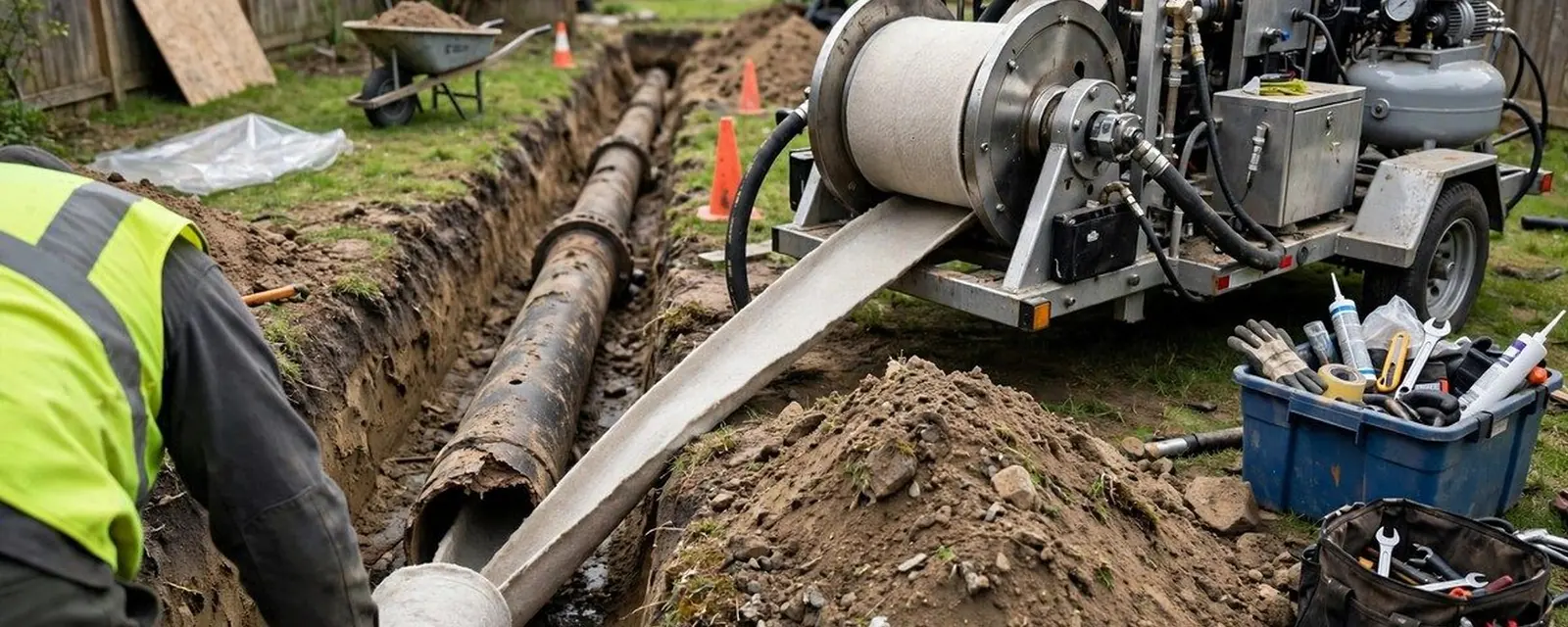
Sewer pipe lining, also called cured-in-place pipe lining, is a way to repair a damaged sewer line without digging a full trench. A flexible tube soaked in resin is pulled into the old pipe, expanded against the walls and hardened. The result is a new pipe inside the old one. In Chesterfield, MO, homeowners ask about it when roots, cracks or repeated backups point to a failing line.
Lining is not a cure for every problem. Offsets, collapsed sections and low spots often rule it out, and a camera inspection decides whether it fits. This guide explains how lining works, what it can and cannot fix, what drives cost and how it compares with digging.
How a cured-in-place liner goes into the pipe
Camera inspection first
A pipe camera shows cracks, roots, offsets, sags and the pipe material. The footage tells you whether lining is even possible.
Cleaning the line
A drain machine or hydro jetter removes roots, scale and debris so the liner bonds to a clean surface.
Preparing and inserting the liner
A felt or fiberglass tube is soaked in epoxy resin, then pulled or inverted into the pipe from an access point.
Inflating and curing
The tube is pressed against the pipe walls, then cured with hot water, steam or ultraviolet light until it hardens.
Reopening connections and a final camera check
A cutter reopens side connections, and a second camera run confirms the liner is smooth and sealed.
What lining can fix and what it cannot
A liner follows the shape of the pipe it goes into. That strength is also its limit.
| Pipe condition | Lining a good fit? | Why |
|---|---|---|
| Root intrusion at joints | Usually yes, after cleaning | The liner seals joints so roots cannot enter |
| Hairline cracks or small holes | Usually yes | Resin bonds over the defect |
| Minor corrosion in old clay or cast iron | Often yes | A new smooth wall replaces the rough one |
| Offset joints where pipes have shifted | Depends on how big | Large steps can snag the liner or leave a ridge |
| Belly or sag holding water | No, the liner follows the dip | Water still collects in the low spot |
| Collapsed or crushed pipe | No | The liner cannot pass or has nothing to bond to |
Only a camera view can place your pipe in one of these rows.
Lining versus digging the line out
Cured-in-place lining
- Needs only one or two small access holes, so lawns, driveways and landscaping stay mostly intact
- Can cover a long run in a single pass
- Slightly reduces the inner diameter, which is rarely an issue for a household line
- Fails to fix bellies and collapsed pipe
Open trench replacement
- Replaces the pipe entirely, so any offset, belly or collapse gets corrected
- Disturbs the yard, and may involve driveways, sidewalks and trees
- Often the only option for a crushed line
- Usually takes more labor and restoration work
Wondering if lining fits your pipe?
A camera inspection comes first because the pipe condition decides everything.
What Chesterfield homeowners should check
The City of Chesterfield says the property owner is responsible for the lateral sewer service line, which is the pipe from the house to the main. The City's Residential Sanitary Sewer Lateral Repair Program covers certain lateral repairs after the line has been cabled by a licensed plumbing company or licensed drainlayer and the cabling did not clear the problem. Routine cabling is not reimbursable.
Whether lining qualifies under that program is not something we can promise. Ask the City's Department of Public Works whether your repair qualifies before you commit, because the City uses its own repair contractor for program repairs. Applications go by mail or in person with a cabling invoice, so keep the paperwork from any cabling visit.
Source types: city website, city sewer lateral program.
What drives the cost of sewer lining
Prices differ from house to house, so any number you hear without a camera inspection is a guess.
Homeowners policies commonly cover sudden accidental damage but not wear and maintenance, so check your policy. We give a clear price before work starts.
Want the real number for your job? Call the 24/7 line, describe the work, and hear a clear price before anything starts.
Signs your sewer line may be a lining candidate
None of these confirm a lining job, but each one deserves a camera look.
- ✓Repeated slow drainsSeveral fixtures drain slowly and cabling gives only short relief.
- ✓Gurgling or sewer odorAir is pushed back through traps because the line is partly blocked.
- ✓Soggy or sunken spots in the yardWet ground along the pipe path can mean a leak.
- ✓Roots return after cleaningRoots grow back within a season, which suggests open joints.
- ✓Older house with original pipeClay, cast iron and old fiber pipe often fail at joints.
Protecting a lined pipe after the work is done
A new liner makes the inside of the pipe smooth, but it does not make the line immune to abuse. Grease, wipes and flushed paper towels still clog a lined pipe the same way they clog any other. Keep fats out of the kitchen drain and flush only toilet paper.
Ask your plumber to leave you the final camera footage, the liner product name and the date of the work. If you sell the house, that record helps the next owner. A camera run every few years on an older line also catches new trouble early, before a backup does.
Why a camera comes before any quote
A pipe camera pushed through the clean-out shows what is actually happening underground. Without it, a lining quote is a guess, and a collapsed section can turn an expected trenchless job into a dig. The footage also lets you see the pipe material and the exact distance to each defect.
Ask for a copy of the video or a still of each problem. Our sewer inspection visit does this, and if the camera finds a defect that cabling cannot fix, our sewer line repair team can talk through lining, spot repair or replacement. We also serve homes in Wildwood and Creve Coeur.
When lining is the wrong call
If the camera shows a belly, a collapse or a severe offset, lining will not correct it, and spending on a liner would be wasted. A very short damaged section is sometimes better handled by a spot repair. If a home is about to be sold or the line is tied to a larger renovation, a full replacement may make more sense.
Sewage in the house or a backup into the basement is an emergency, so call the 24/7 line and stay out of standing water. Keep fixtures from running while you wait.
Questions readers ask
Manufacturers describe liners as long-lasting, but actual life depends on the pipe, installation quality and the conditions underground. Ask for the product's documentation and any warranty terms in writing.
A liner seals the joints and cracks that roots use to enter, so it can stop intrusion at those points. Roots may still press on the pipe from outside, but they cannot get in.
Usually not. A crushed section blocks the camera and the liner, so replacement by digging or another method is typically needed.
It depends on the job. Lining saves on excavation and yard restoration, but a long, heavily damaged line can still be costly. Cost factors include length, diameter, access and cleaning.
We cannot say. The City's lateral repair program covers certain repairs after cabling by a licensed plumber fails to clear the line, so ask the City's Department of Public Works whether your repair qualifies.
Reference points for this guide: The Uniform Plumbing Code (UPC) and the International Plumbing Code (IPC) are the model codes most U.S. jurisdictions adopt, and the local permitting authority decides which edition and amendments apply. Sewer lateral ownership and the repair program are described by the City of Chesterfield. This guide is general information and does not replace a visit.