
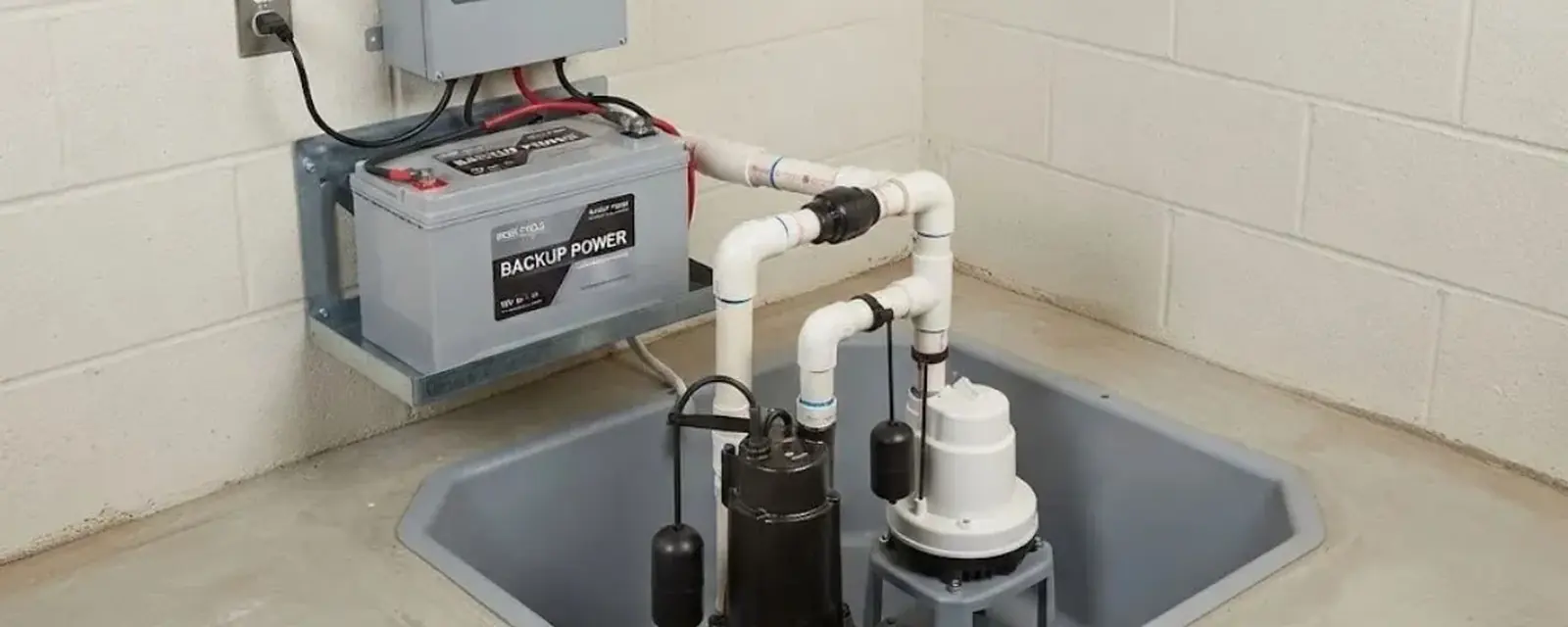
To install a battery backup for a sump pump in Chesterfield, MO, you set a second pump in the pit, give it its own check valve and discharge, wire it to a deep-cycle battery with a charger and test it. Many homeowners can do the swap if the pit is large enough and the discharge is easy to reach.
The risk is the storm that knocks out power at the same moment the pit fills. A backup only helps if it sits at the right height, has a working float and its battery is charged. This guide walks through the choices and the order of work.
Primary pump versus backup pump
The primary pump is the AC pump that runs most of the year. The backup is a second pump that starts when the primary fails or when the water climbs higher than the primary can handle. It can run on battery power or on water pressure from the house supply.
A battery system has a controller, a deep-cycle battery and a charger. It will run a smaller pump for a limited time, often several hours of steady pumping or longer if cycling is light. A water-powered backup needs no battery but depends on municipal water pressure and sends extra water down the drain.
Neither is a substitute for a healthy primary pump. If the primary is old, noisy or running all the time, replace it first.
Choosing a backup that fits your pit
Size matters more than the label on the box. A backup pump moves less water than a large primary, so check its rated output at your discharge height. A pit with high inflow during storms needs a backup with a strong flow rate and a battery that can cycle often.
Look at the pit lid and the discharge height too. A long vertical lift to the outlet cuts the flow of any pump. If your discharge line runs uphill or far from the house, tell the seller or plumber so the pump can be matched.
Buy a deep-cycle battery rated for this kind of use. A standard car battery loses capacity when it is drained and recharged repeatedly.
Which backup type fits which house
Match the backup to how long power tends to stay off and how fast your pit fills.
| Option | Best for | Trade-off |
|---|---|---|
| Battery backup with its own pump | Homes with a standard pit and a short to medium outage | Battery needs charging and replacement over time |
| Water-powered backup | Homes on public water with reliable pressure | Uses extra water, needs adequate pressure |
| Combination primary and backup unit | New pits or full replacements | Less room to adjust, one unit to maintain |
| Whole-house generator | Households that want power for everything | High cost, needs a transfer switch and fuel plan |
| Alarm only | Pits that rarely run, as a stopgap | Warns you but does not move water |
A high-water alarm is useful with any option. It tells you something is wrong before water reaches the floor.
Power fails when storms hit?
That is the exact moment a battery backup pays for itself.
Installing the backup pump, step by step
Check the pit size
Measure the pit width and depth. Two pumps need room to sit side by side with floats that do not tangle. A narrow pit may call for a combination unit or a new pit.
Cut power and clear the pit
Unplug the primary pump and remove standing water. Dry-fit the new pump on a flat base and check it clears the primary.
Set the backup higher than the primary
The backup float should trigger a couple of inches above the primary float so it only starts when the primary fails. Follow the manufacturer spacing.
Add a check valve and a separate discharge
Run a short pipe from the backup pump with its own check valve so water does not flow back into the pit. Tie it into the discharge pipe above the primary check valve.
Wire and mount the controller
Mount the controller and battery above floor level in a dry spot. Connect the pump leads, charger and alarm following the instructions.
Test it
Fill the pit with a bucket until the primary float rises, then unplug the primary and keep adding water. The backup should start. Repeat twice.
When DIY is fine and when to call
The wiring and plumbing involved are modest. The risk is what happens if it fails.
A confident homeowner can handle
- Replacing a backup in an existing, roomy pit
- Connecting a battery and charger to a ready kit
- Adding a check valve to a straightforward discharge
- Setting the float heights and testing the system
- Replacing an aging battery on a schedule
Call a plumber when
- The pit is too small or cracked
- The discharge line is frozen, clogged or long
- The primary pump runs constantly or short cycles
- Wiring needs a new outlet or circuit
- The basement has flooded before and you want a full plan
Why the Chesterfield Valley and the 1993 flood matter for backup power
Chesterfield Valley is low-lying Missouri River floodplain. In the Great Flood of 1993 the Monarch levee gave way on the night of July 30 and about 4,000 acres of the Valley flooded to depths of 6 to 15 feet. The Valley is now protected by the Monarch-Chesterfield Levee.
Nearby homes and buildings still deal with groundwater and storms, and storms are when power fails. A backup pump is a practical response to power loss and a high pit, not a guarantee against flooding. If your property sits low or has flooded before, size the pump with a margin and test it each spring. Ask the City or St. Louis County about permit rules before changing the discharge or adding electrical work.
Source types: Wikipedia summary of city data, St. Louis Public Radio.
Maintenance that keeps the backup working
- ✓Test the backup pump twice a year by raising the float or filling the pit.
- ✓Check the battery date and replace it according to the maker guidance.
- ✓Keep the charger plugged in and the indicator light visible.
- ✓Clean debris from the pit and look at both check valves.
- ✓Make sure the discharge pipe is clear and the outlet is not frozen or buried.
- ✓Review the alarm every few months and replace its batteries.
What affects the cost of a backup pump install
Prices vary by system and by pit. A plumber walks through the basement first.
Homeowners policies often exclude flood and seepage, and some offer a water backup endorsement for sump failure. Ask your agent what yours covers before the storm.
Want the real number for your job? Call the 24/7 line, describe the work, and hear a clear price before anything starts.
Where a plumber helps
If the pit is old or the primary pump is failing, sump pump installation and repair can replace both and set a proper backup. When water shows up through the floor even with a working pump, basement waterproofing looks at the drain path under the slab.
We serve nearby towns as well, including Ballwin and Creve Coeur. If water is already rising, call the 24/7 line and keep clear of the pit and any electrical outlet nearby.
Questions readers ask
It depends on battery size and how often the pump cycles. Runtime ranges from several hours of steady pumping to a day or more with light cycling, so check the maker rating.
Yes, but each pump needs its own check valve so water from one does not flow back through the other. The backup line should join above the primary check valve.
Above. It should start only when the primary fails or the water rises past its normal level. Follow the spacing in the instructions.
Check the maker guidance. Many deep-cycle batteries last a few years with regular charging, and a dated battery should be tested each spring.
The Valley is low floodplain behind the Monarch-Chesterfield Levee, and storms that cause outages are also the ones that fill pits. A backup is a sensible response, though it does not prevent flooding.
Reference points for this guide: The Uniform Plumbing Code (UPC) and the International Plumbing Code (IPC) are the model codes most U.S. jurisdictions adopt, and the local permitting authority decides which edition and amendments apply. This guide is general information and does not replace a visit.