
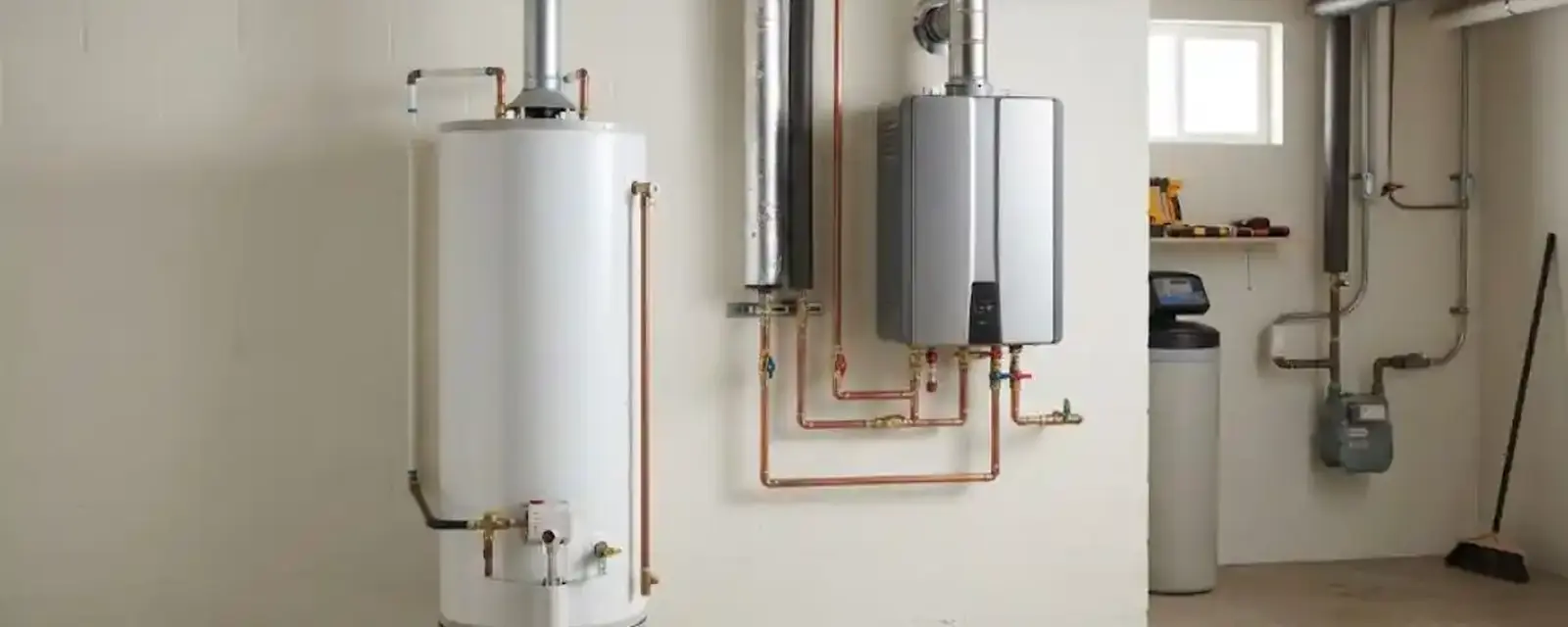
For a family of five in Chesterfield, MO, most homes land on a tankless water heater rated for about 7 to 9 gallons per minute at the temperature rise they need. That is a rule of thumb, not a verdict. The real answer comes from two numbers: how many gallons per minute you run at the busiest moment, and how many degrees the unit must add.
Tankless sizing is not about family headcount alone. A house with two showers going while the dishwasher runs needs more than a house where five people shower at different times. Below is the fixture math with typical flow rates, a worked example, and the gas versus electric trade-offs.
Typical fixture flow rates you can add together
These are typical figures for modern fixtures, labeled as typical because your own may differ. Check the label on your showerheads and the dishwasher and washer manuals for the real numbers.
| Fixture | Typical flow (GPM) | Notes |
|---|---|---|
| Shower | 2.0 | Many showerheads are rated at 2.5 or lower |
| Bathroom sink | 1.0 | Often a 1.0 to 1.5 aerator |
| Kitchen faucet | 1.5 | Higher if you open it fully for pots |
| Dishwasher | 1.5 | Draws hot water during fill cycles |
| Washing machine | 2.0 | Depends on cycle and model |
| Soaking tub fill | 4.0 or more | A large tub may be the biggest single draw |
Flow rates are typical, not measured values for your home. Count only the fixtures that can run at the same time.
The worked example for a busy morning
Picture two showers running while the dishwasher finishes a cycle. That is 2.0 plus 2.0 plus 1.5, so 5.5 gallons per minute of hot water at once. Add a bathroom sink at 1.0 and you reach 6.5 GPM.
Next comes the temperature rise, which is the number of degrees the unit must add. Say the rise is 55 degrees, as an illustration only. The heat needed in BTU per hour is GPM times rise times 500, so 5.5 times 55 times 500 comes to about 151,000 BTU per hour.
That is a large number, and it explains why a family of five often needs a bigger unit than a catalog headline suggests. For electric, divide BTU per hour by 3,412 to get kilowatts, which is how the 44 kW figure below was reached. A smaller rise or lower flow shrinks both numbers quickly, so shorter showers and low-flow heads genuinely help.
Gas versus electric for a household this size
The same demand looks very different depending on the fuel.
Gas tankless
- Whole-house units commonly top out around 199,000 BTU per hour, which covers many busy households
- Needs proper venting and often a larger gas line than your old tank used
- Handles two bathrooms running at the same time when sized correctly
- Higher purchase and install cost, lower energy cost per gallon for many homes
Electric tankless
- The same 5.5 GPM at a 55 degree rise needs roughly 44 kW, which is a big load for most panels
- No vent and simple placement, but heavy wiring and large breakers
- Works best for lower flow, point-of-use or a small second bathroom
- Often needs a panel upgrade for a family of five if used as the only heater
Sizing a tankless unit for a full house?
Peak flow, not family size alone, decides the right model.
What Chesterfield homeowners should check
Missouri American Water's 2021 St. Louis region report says about 80 percent of its surface water comes from the Missouri River and about 20 percent from the Meramec River. Surface water is colder in winter than water from deeper sources, so the temperature rise your heater must add is larger in January than in July. Size for the cold months, not the summer ones.
The same report gives Missouri River facility hardness of 76 to 170 mg/L as calcium carbonate, about 4.4 to 9.9 grains per gallon. That is hard enough to scale a tankless heat exchanger over time. Ask Missouri American Water for the latest report and which treatment plant serves your address, and plan for a descaling schedule.
Source types: utility water quality report, city website.
Five numbers to write down before you buy
Bring these to any quote conversation so the sizing is based on your house and not a catalog.
- ✓Peak simultaneous GPMAdd up the fixtures that really run together in your home.
- ✓Winter incoming water temperatureMeasure at the kitchen tap with a thermometer after a cold night.
- ✓Desired shower temperatureMost people choose a setting near what the manual recommends.
- ✓Gas line size and meter capacityAsk your gas utility or plumber what your line can carry.
- ✓Panel space and amperageElectric units need multiple double-pole breakers.
Two bathrooms at once: the case that breaks undersized units
When two showers and a kitchen draw overlap, an undersized unit cannot hold the temperature. It cuts back flow or the water turns lukewarm. That is not a defect. It is arithmetic. A heater that meets the rise at 4 GPM will fall short at 6.5 GPM, and the rise it can deliver drops as the flow goes up.
Two common fixes exist. One is a larger single unit. The other is two smaller ones, for example a whole-house unit plus a point-of-use heater for a far bathroom. Pipe length matters too, because a far fixture waits longer for hot water no matter how large the heater is. Our tankless water heater team can run the numbers with you.
What drives the price of sizing up
A larger unit costs more, but the equipment is only part of the bill.
Homeowners policies commonly cover sudden accidental damage but not wear and maintenance, so check your policy before a replacement is needed. We give a clear price before work starts.
Want the real number for your job? Call the 24/7 line, describe the work, and hear a clear price before anything starts.
Getting the job done right
A sizing worksheet is a good start, but a licensed plumber should confirm gas line capacity, venting and clearances before anyone orders equipment. Our water heater installation crew handles the removal of the old tank and the hookup, and we serve homes across Chesterfield and in Wildwood and Town and Country.
If your hot water has already failed, call the 24/7 line and we can talk through what to do while you decide on a long-term answer.
Questions readers ask
Many families of five need roughly 7 to 9 GPM for a busy morning, but the real figure is the sum of fixtures that run together. Two showers plus a dishwasher is about 5.5 GPM before you add a sink.
Often yes if it is sized for both showers at once. Otherwise a second small unit near the far bathroom helps. Distance also affects how long hot water takes to arrive.
Gas usually handles high flow with less strain on your electrical panel. Electric suits lower flow or secondary use. Panel capacity decides whether electric is practical for the whole house.
Subtract your coldest incoming water temperature from the temperature you want at the tap. Then multiply GPM by that rise by 500 to get BTU per hour for gas sizing.
Missouri American Water's 2021 report says most of its supply is surface water from the Missouri and Meramec rivers, which is colder in winter. A larger temperature rise means a larger unit for the same flow.
Reference points for this guide: The Uniform Plumbing Code (UPC) and the International Plumbing Code (IPC) are the model codes most U.S. jurisdictions adopt, and the local permitting authority decides which edition and amendments apply. Water hardness figures come from Missouri American Water and its 2021 water quality report for the St. Louis region. This guide is general information and does not replace a visit.