
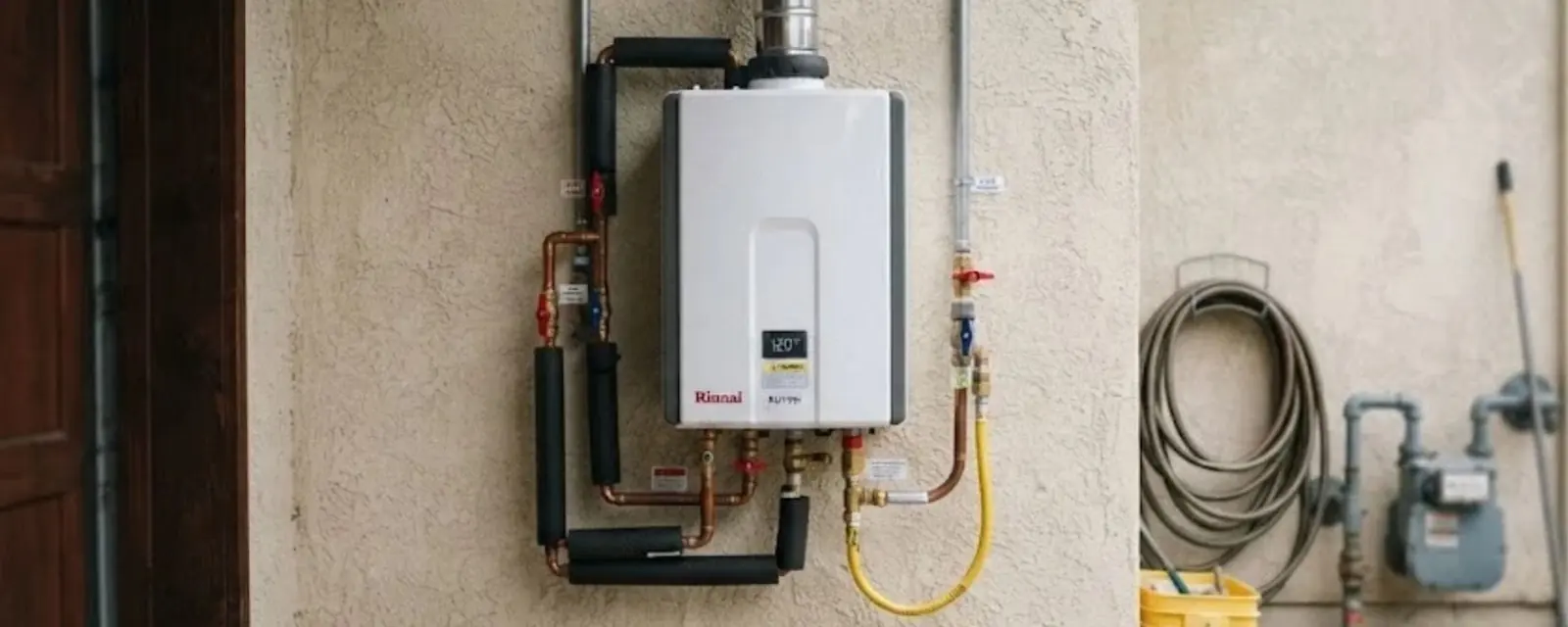
The shower runs hot, then lukewarm, then hot again. The display flashes a code you have never seen. Or the water barely trickles from the hot side while the cold runs fine. Those are the usual reasons people search for tankless water heater help in Chesterfield, MO, and most trace back to scale, flow or venting, not a dead unit.
This page starts with the symptoms, shows how the cause is found, and then covers flushing, repair, electric versus gas, venting and sizing basics. We also say where a tankless unit is the wrong fit.
Tankless symptoms and what usually causes them
A tankless unit has no tank to blame, so each symptom points to a short list of parts. This table is the starting point for our diagnosis.
| What you notice | Common causes | First step |
|---|---|---|
| Water runs hot, drops to lukewarm, then hot again | Flow below the unit's minimum, scale on the heat exchanger, or a mixing issue | Try a higher flow at one fixture and see if it steadies, then plan a descale |
| Error code on the display | Ignition failure, flame sensor, exhaust or venting fault, high limit from scale | Look the code up in the manual, power cycle once, then call if it returns |
| Weak flow from hot taps only | Clogged inlet filter screen or scaled heat exchanger | Clean the inlet screen, which is a safe homeowner step on most models |
| Water never gets hot enough in winter | Unit is undersized for the temperature rise, or one fixture is draining more than expected | Check the setpoint, then ask whether the unit matches the house |
| Takes long for hot water to arrive | Long pipe run from the unit to the fixture, not a heater fault | Time it, then discuss a recirculation option |
| Unit shuts off while running | Blocked vent or condensate drain, low gas supply, or an overheating exchanger | Check the vent termination for debris and call if it persists |
If you smell gas near the unit, leave the house and call the gas utility or 911 before anything else. A fault code is never worth staying in a gas smell for.
How we find the cause of a tankless problem
Read the code and history
Many units store recent faults. The code and the pattern tell us whether this is combustion, flow, temperature or venting.
Check flow and temperature rise
We measure the inlet and outlet temperature while one tap runs at a set flow. A low rise at full flow means scale or a failing burner or element.
Inspect the vent and gas or power supply
On gas units we check the vent termination, the gas pressure and the condensate line. On electric units we check the breakers and the incoming voltage.
Pull the inlet filter and look inside
A screen packed with grit explains a lot, and a white crust on the exchanger explains the rest.
Decide: flush, repair or replace
You hear the cause, the cost and an honest view on whether the unit has more life in it.
Tankless water heater flush and descaling
Scale is the number one service issue on tankless units. The heat exchanger is a narrow passage, and a thin crust cuts flow, raises exit temperature and trips high limit codes. A flush circulates a descaling solution, usually white vinegar or a manufacturer approved product, through the exchanger with a small pump and hoses connected to isolation valves.
A flush is only possible if the unit has service valves on the hot and cold lines. If yours does not, we add them first, because without them the cleaning is guesswork. After circulating for the time your manual specifies, we rinse with clean water, clean the inlet screen and test output temperature.
Flushing helps more than it harms. But if scale has already cracked a heat exchanger or burned out a flow sensor, descaling will not repair that damage, and you may be looking at a part replacement or a new unit.
Tankless unit throwing errors?
Scale from hard water causes many of them, and a descale often brings the unit back.
How often to flush in Chesterfield water
Missouri American Water supplies most of St. Louis County. Its 2021 St. Louis region report listed hardness of 76 to 170 mg/L at Missouri River plants, about 4.4 to 9.9 grains per gallon, and 66 to 148 mg/L at Meramec River plants, about 3.9 to 8.7 grains. Ask Missouri American Water for the latest report and which plant serves your address.
Water in that range will form scale. Many manufacturers call for a yearly flush in hard water areas, and some units with a lot of use benefit from sooner. Read your manual, and consider a water softener if you are descaling often. A softener also protects the faucets and appliances downstream.
Gas versus electric tankless: what each needs
The fuel decides the install cost and the maintenance. Both heat water well when the house supports them.
Gas tankless
- Heats large flows and can serve several fixtures at once
- Needs a gas line sized for the unit's burner, often larger than a tank needs
- Needs a sealed vent through a wall or roof, and a condensate drain on condensing models
- Has combustion parts that need checking, and a burner to keep clean
- Do not run it with a blocked vent
Electric tankless
- No vent and no gas, so placement is flexible
- Needs heavy electrical service, sometimes several breakers, and may need a panel upgrade
- Best for point of use or a house with modest hot water demand
- Coils can fail from scale and are cheaper to replace than a gas exchanger
- Winter incoming water is cold, so the unit has to work harder
Venting, minimum flow and sizing basics
These three things trip up more installs than the brand does.
Venting
Condensing gas units can vent in plastic pipe through a side wall. Non-condensing units run hot exhaust and need stainless vent. Terminations need clearance from windows, doors and meters.
Minimum flow
Tankless units need a minimum flow to fire. A trickle at a low-flow fixture may not turn the burner on, which is why some taps run cold when barely open.
Sizing
Capacity is set by how much hot water you use at once and how cold the incoming water is. In Missouri winters, the incoming temperature is the part people underestimate.
Hot water lag
The wait for hot water depends on pipe length from the unit, not the heater. A recirculation line shortens it.
What affects the cost of tankless service and installation
Service jobs and installs are different budgets. A flush is a short visit. A new installation reshapes pipes, gas and venting.
Homeowners insurance generally does not pay for maintenance or wear on a tankless unit. Sudden damage from a burst line may be covered, so check your policy.
Want the real number for your job? Call the 24/7 line, describe the work, and hear a clear price before anything starts.
Honest limits on tankless repair
Not every brand or model is practical to repair. Some boards, heat exchangers and proprietary sensors are expensive, sold only through the manufacturer or discontinued. When a repair approaches the price of a new unit, we say so and show your options.
Tankless is also not the right answer for every home. If your gas line is small, venting would require a major rebuild, or a large household runs several showers at once, a storage tank may serve you better. If your tankless water heater is leaking, treat it like any other leak: shut off the water and fuel and call the 24/7 line.
For storage tanks, see water heater repair and water heater replacement. If you are planning a conversion, water heater installation explains the gas, venting and electrical decisions, and neighbors in Creve Coeur get the same walk-through.
Questions about tankless water heater service in Chesterfield
Common causes are flow dropping below the minimum, scale on the exchanger, or two fixtures drawing more than the unit can heat. A flush and a flow check usually narrow it down.
If the unit has isolation valves, a small pump and a gallon or two of vinegar can do it. Follow your manual, and call if you are unsure about gas shutoff, venting or hot water burns.
It varies by brand. Ignition, flame, exhaust and high limit faults are the usual groups. The manual lists the code, and we diagnose what is behind it.
It can be if you have a large household, limited floor space and a gas line and vent route that suit it. It is a poor fit when the install needs big changes. We help you compare before you commit.
They are often rated for a longer life when maintained, but scale shortens that. Hard water is the reason the flush schedule matters.
We diagnose most units, but parts availability varies by brand, and some repairs are not practical. We tell you before work starts.
A short wait is normal, longer depending on pipe length. If it is unusually long, a recirculation loop or a closer unit helps.
Reference points for this page: The Uniform Plumbing Code (UPC) and the International Plumbing Code (IPC) are the model codes most U.S. jurisdictions adopt, and the local permitting authority decides which edition and amendments apply. Water hardness figures come from Missouri American Water and its 2021 water quality report for the St. Louis region.