
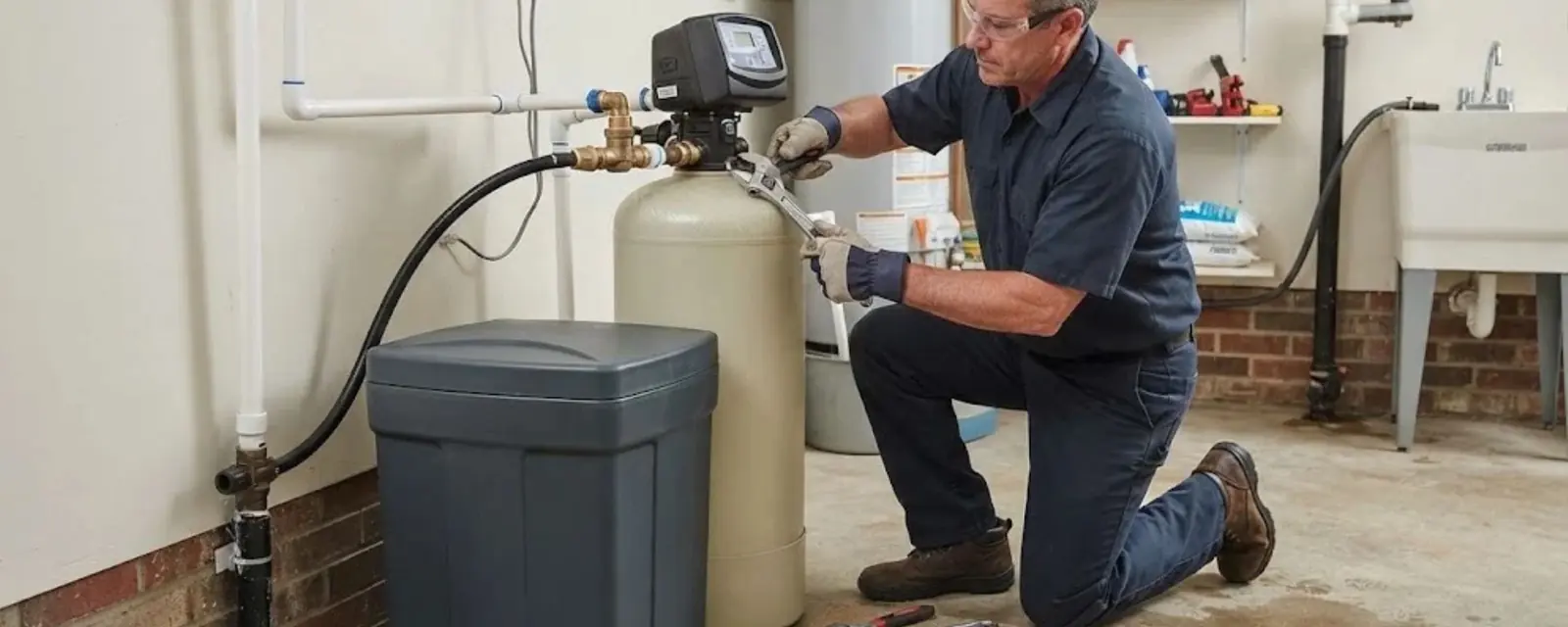
White crust around the faucet, a cloudy film on the glass shower door and a water heater that sounds like popcorn all suggest hard water. Before you shop for a water softener installation in Chesterfield, MO, find out how hard your water really is, because that number sets the size and the price.
Most St. Louis County homes get water from Missouri American Water. Its 2021 St. Louis region report lists hardness in a range, not one figure for every house. We help you read it, test your own tap, and decide whether a softener, a sink filter or nothing at all is the sensible next step.
Signs the water is hard, and signs it is something else
Scale is the visible side of hardness. Other complaints that look similar need different equipment, so sort them out first.
Chalky crust on fixtures and aerators
Dissolved calcium and magnesium dry into scale. It clogs aerators and showerheads and builds up on heating elements.
Soap that will not lather and dull laundry
Hard water fights with soap and leaves residue on skin and fabric.
Water heater that rumbles or runs out early
Scale collects at the bottom of a tank and coats the heating element. A flush helps, though a softener slows the return.
Taste or smell of chlorine
This is not hardness. A softener will not remove it, but a carbon filter will.
Brown or orange staining
Iron or old pipe rust. Some softeners handle small amounts of iron, but heavy staining needs its own treatment.
What the 2021 water quality report says about hardness
Missouri American Water's St. Louis region report for 2021 says about 80 percent of the surface water comes from the Missouri River and about 20 percent from the Meramec River. Hardness at the Missouri River facilities ran from 76 to 170 mg/L as calcium carbonate, which is about 4.4 to 9.9 grains per gallon. At the Meramec River facilities it ran from 66 to 148 mg/L, or about 3.9 to 8.7 grains per gallon.
Those are 2021 numbers, and your own address could sit anywhere inside or beside those ranges. Ask Missouri American Water for the latest report and which treatment plant serves your address. Then check your own tap with a test kit so you size the equipment for real water, not a regional average.
Grains per gallon, milligrams per liter and what they feel like
Reports use mg/L while softener sellers talk in grains per gallon. One grain per gallon equals 17.1 mg/L, so you divide the report figure by 17.1.
| Hardness (mg/L) | Grains per gallon | What you tend to notice |
|---|---|---|
| Under about 60 | Under about 3.5 | Little visible scale |
| About 60 to 120 | About 3.5 to 7 | Spots on glassware, slow scale on kettles and aerators |
| About 120 to 180 | About 7 to 10.5 | Visible crust, soap film, scale in water heaters and tankless units |
| Above about 180 | Above about 10.5 | Heavy scale, shortened appliance life, a softener is usually worth pricing |
Bands follow the common soft, moderate, hard and very hard classes, not a regulatory limit. The 2021 report ranges above sit in the middle two rows, which is why testing your own tap matters.
Spots, scale and stiff laundry?
Those are hard water signs, and a test shows what treatment really fits.
How we size and install a softener
Test the water at your tap
We use a hardness test strip or titration kit and, if iron is a concern, an iron test as well.
Count the household
People and daily water use drive how many grains of hardness the unit has to remove each day.
Do the capacity math
Daily gallons times grains per gallon gives grains per day. A household using 300 gallons at 8 grains per gallon removes about 2,400 grains a day. The unit should hold several days of that before it regenerates.
Pick the location
The unit needs a drain for the backwash, a power outlet nearby and a spot where the bypass valve is reachable.
Install and plumb in
We set the unit, add a bypass, connect the drain with an air gap and check for leaks before programming it.
Set hardness and test the result
We program the valve to your measured hardness and test the treated water. A whole-house unit softens hot and cold, and many people leave one outside tap on hard water for the lawn.
Salt softener or salt-free conditioner
The word conditioner makes this confusing. Only one type actually removes the hardness minerals.
Salt-based softener
- Removes calcium and magnesium through ion exchange
- Needs salt or potassium chloride refills
- Uses water and a drain for regeneration
- Adds a small amount of sodium to the water
- Gives soft water with no scale
Salt-free conditioner
- Does not remove the minerals, it changes how scale forms
- No salt and no drain connection
- Reduces how hard scale sticks to surfaces
- Does not give the slippery feel of soft water
- Results vary by water and equipment
Reverse osmosis at the sink and whole-house filters
A reverse osmosis unit under the kitchen sink filters drinking water through a membrane, with a small tank and its own faucet. It improves taste and reduces many dissolved solids, but it only treats that one tap, and it sends some water to the drain. For taste or odor in the whole house, a carbon filter ahead of the water heater is the more common answer.
A softener and a filter do different jobs. A softener handles hardness, a filter handles sediment, taste and odor, and neither one removes everything. Tell us your goal and we will say which piece you actually need. Larger systems often pair with new plumbing installation work when a house is being updated.
What a softener will not fix
Buying the wrong equipment is the most common regret. A softener does not do these things.
- ✓Remove chlorine taste or odor. That needs carbon filtration.
- ✓Make water safe if it tests positive for bacteria.
- ✓Fix low water pressure. Clogged pipes and a failing regulator are separate problems.
- ✓Remove lead. Ask a lab or your water utility about testing.
- ✓Clear scale already built up inside old pipes and tank water heaters.
- ✓Solve a sewer smell or a rotten egg odor from a water heater.
Repairing a softener that has stopped working
Many softeners are still worth fixing. We service existing units and the controller valves on them.
Hard water despite a full salt tank
Salt can bridge into a crust above the water. A broken crust, a bad injector or a stuck valve is often the cause.
Valve will not cycle
A worn motor, stuck piston or failed timer keeps the unit from regenerating. We test the valve before we replace it.
Water or salt mush in the brine tank
A clogged line, a failed float or a bad injector can leave the tank overfilled.
Resin worn out
Resin beads lose capacity over many years. If the unit is old and the resin is gone, replacing the unit may cost about the same as a new tank of resin.
What decides the cost of a softener or filter job
We give a clear price before work starts. These are the pieces that change it.
Homeowners insurance does not usually cover water treatment equipment or wear, though a leak that causes sudden damage may be covered. Check your policy.
Want the real number for your job? Call the 24/7 line, describe the work, and hear a clear price before anything starts.
Hard water, water heaters and nearby towns
Scale is why many people call about tankless water heaters and why tank owners flush annually. If your unit already struggles, see our water heater repair page. We also size equipment for homes in Wildwood and Town and Country. Confirm who supplies your water and ask for their latest report before you buy treatment equipment.
Questions about water softener and filtration in Chesterfield
In the 2021 Missouri American Water report, hardness ran about 3.9 to 9.9 grains per gallon across the Missouri and Meramec facilities. Ask the utility for the latest report and which plant serves your address, then test your own tap.
It depends on household size and measured hardness. Multiply daily gallons by grains per gallon, then choose a unit that stores several days of that capacity.
No, they do different things. A softener removes hardness minerals, while a salt-free conditioner changes how scale forms and does not remove them.
Often yes. A worn motor, stuck piston or failed timer can be replaced on a sound tank. If the tank and resin are worn out, replacement can make more sense.
Not by itself. Chlorine taste responds to carbon filtration, and a rotten egg smell usually points to the water heater or the supply, not hardness.
Not necessarily. Reverse osmosis treats drinking water at one tap. Many households use a softener for scale and an RO unit only if they want a cleaner-tasting glass.
Reference points for this page: The Uniform Plumbing Code (UPC) and the International Plumbing Code (IPC) are the model codes most U.S. jurisdictions adopt, and the local permitting authority decides which edition and amendments apply. Water hardness figures come from Missouri American Water and its 2021 water quality report for the St. Louis region.