
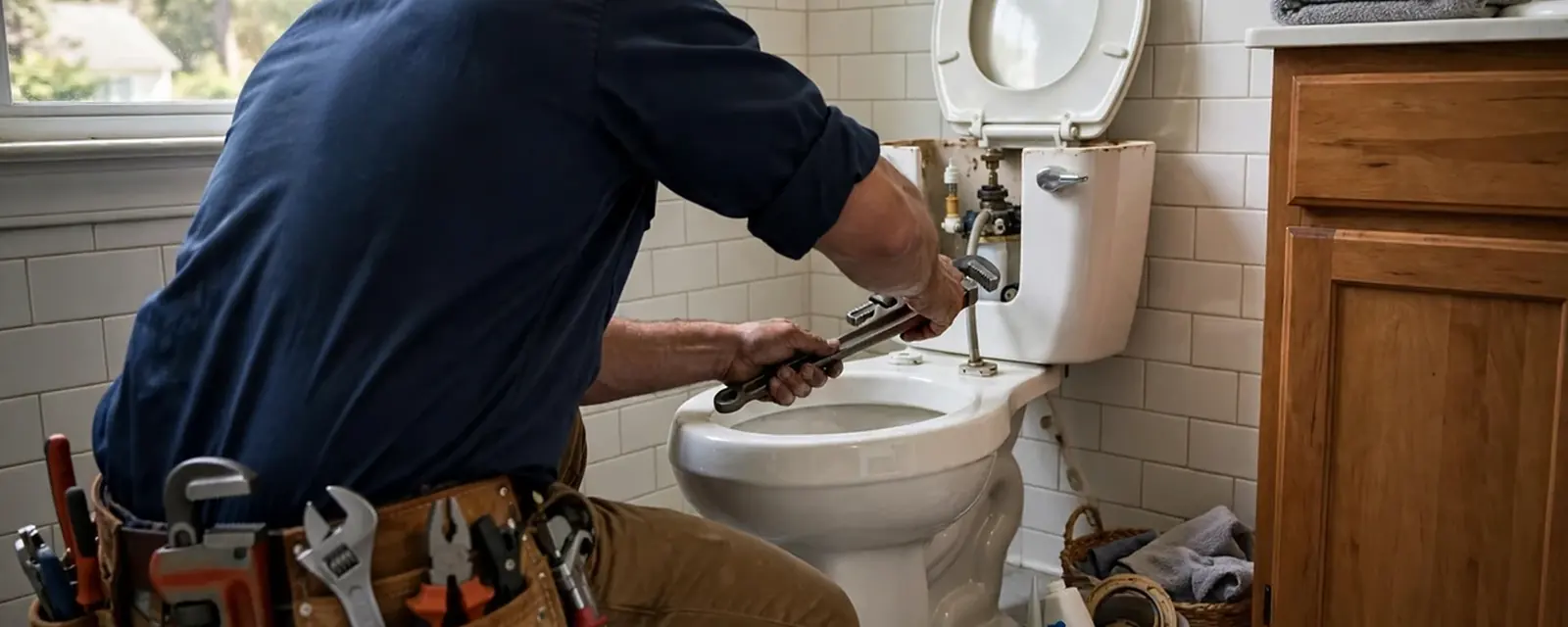
A toilet that is about to overflow does not wait for business hours. If you need toilet repair in Chesterfield, MO, reach for the shutoff valve on the wall or floor behind the bowl and turn it clockwise until it stops. That cuts the refill and usually saves the bathroom floor. Then call the 24/7 line and tell us what the water is doing.
Most toilet calls are not floods. They are a bowl that rocks, a damp ring around the base, a tank that refills every few minutes, or a flush that barely moves the water. Each one points to a different part, and a few point below the floor.
When a toilet overflow is an emergency
A bowl that rises toward the rim and keeps rising is an emergency, especially upstairs where water reaches the ceiling below within minutes. The same goes for sewage backing up through the toilet, or water seeping out from the base of a toilet on a finished floor. Do not keep flushing to test it. Every flush adds more water to a drain that is already blocked.
If sewage is coming up in a tub or floor drain as well, the blockage is in the main line, and sewer line cleaning is the fix.
- 1Lift the tank lid and push the rubber flapper closed, or lift the float arm, to stop the tank from emptying into the bowl.
- 2Turn the supply valve under the tank clockwise to stop new water. If it will not turn, shut the main valve where the line enters the house.
- 3Put towels at the base and move rugs, bath mats and anything electrical away from the wet area.
- 4Skip the chemical drain cleaner. It sits in the bowl, burns skin and can splash back onto whoever uses a plunger next.
- 5Call the 24/7 line and say whether the water is clean tank water or dirty drain water. That changes what we bring.
What your toilet is telling you
The symptom usually narrows the cause before anyone touches a tool. This is how we read the common ones.
| What you notice | Likely cause | What happens next |
|---|---|---|
| Toilet rocks or shifts when you sit | Loose closet bolts, a failed seal or a soft spot around the flange | Tighten and re-seat if the floor is sound. Check the flange if it keeps moving. |
| Water pooling around the base | Failed wax ring, cracked bowl or a loose supply connection | Dry the floor, add dye or paper to find the source, then reset or replace the part. |
| Tank refills every few minutes | Worn flapper letting water seep into the bowl | Swap the flapper and check the seat for pitting. |
| Hissing or constant trickle | Fill valve that no longer shuts off | Replace the fill valve and set the water level to the overflow tube mark. |
| Weak flush, slow swirl | Clogged rim jets, partial blockage or low tank water | Clear the jets and trap, then check the drain line. |
| Water rising and not draining | Blockage in the trap or the line beyond it | Plunge once, then call if it does not move. Do not flush again. |
A single plunge is fine for a simple clog. If two or three tries do nothing, the blockage is likely past the toilet and needs a drain machine.
Running toilets waste more than the noise suggests
A toilet that runs for a few seconds after every flush is annoying. One that runs all day can pass a lot of water without anyone noticing until the bill arrives. The usual culprits are a flapper that has gone soft, a chain that is too tight or too loose, or a fill valve whose seal is worn.
A simple dye test tells us which. We drop a few drops of food coloring in the tank, wait without flushing, and look at the bowl. Color in the bowl means the flapper is leaking. A clear bowl with a tank that still refills points at the overflow tube or the fill valve.
Flappers and fill valves are cheap parts and a short job. We replace them rather than adjust them when the rubber is brittle, because a patched flapper tends to fail again in a few months.
Toilet overflowing or running nonstop?
Close the stop valve behind the bowl first, then call if it will not settle.
How a toilet repair visit goes
Find the water
We check whether the leak is clean supply water, tank condensation or drain water. Each one has a different fix, and a damp towel under the supply line settles it fast.
Test the parts
We run the flush, look at the flapper seat, fill valve and tank bolts, and rock the bowl gently to feel for movement at the floor.
Give you the price
Before any part comes off, we explain what is wrong and what it will cost in plain terms. You decide whether to repair or replace.
Repair or reset
Small parts get swapped in the tank. A leaking base means pulling the toilet, scraping the old seal and setting it on a fresh one.
Test and clean up
We flush several times, check the base and supply connections for drips and wipe the area down before we leave.
When the flange or the floor is the real problem
A wax ring is a small seal between the toilet and the drain flange. When it fails, water seeps out at the base, and replacing it is a routine part of toilet repair. But if a new seal leaks again within weeks, the problem is rarely the wax.
The flange is the ring bolted to the floor that the toilet sits on. If it is cracked, corroded or sitting below the finished floor after new tile, the seal cannot compress properly. Flange repair rings, spacers or a new flange fix those cases.
Long term leaks do more damage. Water that has soaked into the subfloor, sometimes traced with leak detection gear when the source is hidden, can leave it soft, and no seal will hold a toilet steady on rotted wood. We will tell you honestly if the floor needs carpentry before the toilet goes back, and we do not patch over it.
Repair the old toilet or put in a new one
Not every toilet is worth saving. The choice depends on the age of the bowl, what is failing and how often it has been fixed.
Repair makes sense when
- The bowl and tank are uncracked and flush well
- The problem is a flapper, fill valve, handle or supply line
- The seal failed but the flange and floor are sound
- You like the model and parts are still available
Replace makes sense when
- There is a hairline crack in the bowl or tank
- The toilet clogs repeatedly even with a clear drain
- Parts are discontinued or the tank is stained and fragile
- A flange or floor repair means pulling it anyway
Planning a new toilet installation
Buying the toilet is the easy part. Fit is what trips people up, so check these before you carry one home.
Rough-in distance
Measure from the finished wall behind the toilet to the center of the floor bolts. The usual distance is 12 inches, but 10 and 14 exist. A mismatch leaves the tank touching the wall or the bowl standing out.
Bowl shape and height
Elongated bowls sit longer than round ones and need extra room in front. Taller comfort height models are easier on knees but may not suit a child.
Supply valve and line
An old, stiff or leaking shutoff valve is replaced at the same visit. Reusing a tired valve is how a new install ends up leaking again.
Old toilet removal
We drain the old unit, lift it out, scrape the flange clean and check it before setting the new one on a fresh seal.
What drives the cost of toilet work
A flapper swap and a full floor repair are very different jobs, so we do not guess a number over the phone. These are the things that move the price.
Homeowners policies commonly cover sudden accidental water damage but not wear or slow leaks, so check your policy if water has reached the floor or ceiling.
Want the real number for your job? Call the 24/7 line, describe the work, and hear a clear price before anything starts.
Permits and licensing for toilet installs
Swapping a like-for-like toilet is routine, but moving one or adding a new bathroom is a different scale of work. Permit rules vary, so ask the City of Chesterfield or St. Louis County before work that may need a permit. Plumber licensing in Missouri is set locally, so confirm any plumber's licence with the building department where the job is. We also serve homes in Town and Country and across St. Louis County.
What not to do with a failing toilet
- ✓Do not keep flushing a slow toilet to see if it clears. It can overflow in the middle of the test.
- ✓Do not put a brick or bottle in the tank to save water. It can block the flapper from seating.
- ✓Do not use a plunger with caustic cleaner standing in the bowl.
- ✓Do not caulk around the base to hide a slow leak. Water trapped under the toilet rots the floor unseen.
- ✓Do not over-tighten closet bolts. Porcelain cracks, and a cracked bowl means a new toilet.
Questions about toilet repair and installation in Chesterfield
Yes. Our dispatch line runs 24/7 and we offer same-day appointments when available. Shut off the supply valve behind the toilet while you wait.
Most often the flapper is worn and lets tank water leak into the bowl, or the fill valve will not shut off. Both are small repairs that we usually finish in one visit.
Often it is just loose bolts or a failed seal. If the toilet loosens again after we reset it, we check the flange and the floor underneath for the real cause.
Yes. A slow leak at the base can run under flooring or into the ceiling below. Look for soft flooring, a musty smell or a stain beneath a second-floor bathroom.
We can set a toilet you supply, as long as it fits the rough-in. We check that distance first so you do not carry home the wrong size. For repair help in nearby towns, see our Creve Coeur coverage.
If other drains gurgle or a basement floor drain backs up, the blockage is probably in the main line. A drain machine visit or sewer line cleaning is the right next step.
Reference points for this page: The Uniform Plumbing Code (UPC) and the International Plumbing Code (IPC) are the model codes most U.S. jurisdictions adopt, and the local permitting authority decides which edition and amendments apply.