
Irrigation system leak detection in Chesterfield, MO starts with the symptoms you can see. One zone that stays soggy a day after it runs. A patch of grass that is greener than the rest. A spray head that barely reaches. Or a water bill that jumped in a month when the lawn did not seem to need more.
A buried leak wastes water and can undermine soil under a patio or walkway. The meter test below takes about ten minutes and tells you whether the leak is in the sprinkler system, in the house or in the service line.
The meter test with irrigation turned off
Stop all water use
Close every faucet, make sure the dishwasher and washing machine are idle and turn off the irrigation controller so no zone starts mid-test.
Read the meter
Open the meter lid and look at the small leak indicator, usually a triangle or a dial that spins with any flow. Write down the full reading.
Wait and watch
Wait at least 30 minutes without using any water. Read it again. A moving indicator or changed number means water is escaping somewhere.
Isolate the irrigation
Close the irrigation supply valve, then read the meter again. If the movement stops, the leak is in the sprinkler side. If it keeps moving, look at the house or the line from the meter.
Check the toilets
A silent toilet leak can mimic a sprinkler problem. Put a few drops of food coloring in each tank and wait twenty minutes.
Symptom, likely cause and next move
Irrigation leaks hide underground, so the lawn and the pressure tell the story.
| What you notice | Likely cause | Next step |
|---|---|---|
| A zone is wet or has standing water after it shuts off | Cracked lateral pipe or a valve that does not close | Mark the soggy spot and run that zone by itself |
| Spray heads lift weakly or mist | Low pressure from a leak or a partly closed valve | Compare pressure at the backflow device to the house |
| Greener or lush patch in a straight line | A buried leak feeding the soil | Probe the area with a screwdriver and dig carefully |
| Bill jumps with the same watering schedule | Leak or a stuck valve | Run the meter test and read the controller |
| Water rising in the valve box | Failed valve diaphragm, solenoid or fitting | Open the box, find the dripping part, and shut off the zone |
| Dripping or spitting at the backflow device | Worn seat, cracked body or freezing damage | Have the device tested or replaced by a professional |
Never dig near gas lines, electrical conduit or fiber. Call 811 before digging deep and ask the utilities to mark their lines.
What to look for in the valve box
The valve box is the green or black lid set flush in the lawn, and it holds the zone valves. Open it and look for standing water, a hissing valve, a loose wire connector or a cracked fitting. A zone valve that does not seal fully can leak slowly into the downstream line for hours after the zone stops.
Wear gloves and watch for insects. If a solenoid is the problem, turning it by hand a quarter turn often shows whether the valve opens and closes. If water keeps trickling with the solenoid off, the diaphragm or the valve body is the likely culprit.
Many valve boxes fill with mud and become a pool. Clear the water out before you look so you can see where fresh water enters.
Soggy patch with the sprinklers off?
Shut the zone valve and note which zone feeds that spot.
Backflow device notes
The backflow preventer protects drinking water from garden chemicals and lawn runoff.
Where it sits
Usually on a short run of pipe near the house, either above ground or in a box. It has test cocks and a body that holds a check assembly.
What a leak means
A steady drip at the relief port can signal a debris-fouled check or a worn seal. This is not a simple tighten-and-forget job.
Why testing matters
Some utilities and municipalities require periodic testing of these devices. Ask the City or St. Louis County whether a test or permit applies to your system.
Freeze damage
A device left full of water can crack in winter. A cracked body leaks when you turn the system back on in spring.
Winter shutdown guidance for Chesterfield irrigation
Missouri American Water advises customers in cold weather to know where the main shutoff valve is, usually near the meter or where the line enters the house, and to test it. It also advises insulating exposed pipes and draining and turning off irrigation systems.
That matters here because a system left charged through a hard freeze can crack a valve, a backflow body or a lateral, and you may not see it until spring. Drain the lines, close the irrigation supply and leave the controller off for winter. If a pipe does freeze, shut off the main first, warm the area gently, never use open flame and restore water slowly while you check joints.
Source types: utility winter guidance.
What you can check yourself and what needs a locator
A homeowner can narrow the search a lot. Confirming and fixing a buried leak is slower without the right tools.
Homeowner checks
- Run each zone separately and watch the heads
- Do the meter test with irrigation off
- Look in every valve box for water
- Check for a stuck or clogged head
- Lower the water pressure and see if the leak stops
When to bring in a plumber
- The meter moves with every fixture off and the irrigation closed
- A leak sits under a driveway or patio
- You cannot tell which zone or line is leaking
- The backflow device drips or needs testing
- Wet soil or sinking ground near the foundation
What changes the cost of finding an irrigation leak
The price follows how hard the leak is to reach and how much needs repair.
Homeowners policies commonly cover sudden accidental water damage but not wear, and often exclude the cost of finding and fixing a slow underground leak. Check your policy.
Want the real number for your job? Call the 24/7 line, describe the work, and hear a clear price before anything starts.
How we find the leak
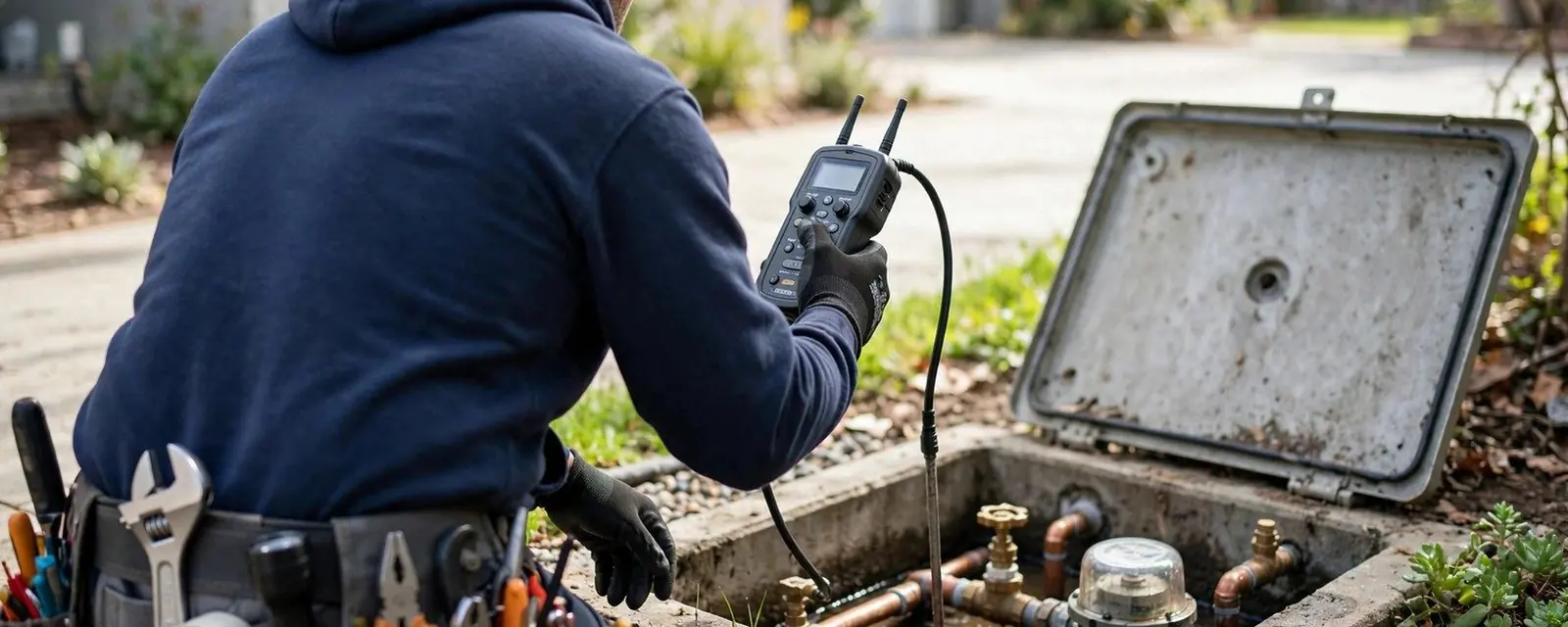
We start with the meter and a pressure gauge on a hose bib. If the irrigation side is the culprit, we close it off and test each zone. An acoustic leak detector picks up the sound of water escaping from a pressurized pipe, and a moisture meter confirms damp ground.
Our leak detection work narrows the spot before any digging, so the repair is small. For new valves, zone changes or a backflow upgrade, plumbing installation covers the connection work. Commercial and HOA properties with larger systems can ask about commercial plumbing service.
Questions readers ask
Look for soggy zones, weak spray heads, a green strip in the lawn or a higher bill. Then run the meter test with irrigation off.
Yes. A cracked lateral or a valve that will not close can run for days and add a lot of use. The meter test shows whether the sprinkler side is responsible.
It is usually near the backflow device or where the irrigation line branches from the house supply, often in a basement, crawl space or box. Locate it before you need it.
A loose fitting or a bad solenoid is often a simple swap. If water keeps flowing with the zone off or the valve body is cracked, call a plumber.
Missouri American Water guidance is to drain and turn off irrigation systems and to know where the main shutoff valve is. Do this before a hard freeze to avoid cracked valves and backflow bodies.
Reference points for this guide: The Uniform Plumbing Code (UPC) and the International Plumbing Code (IPC) are the model codes most U.S. jurisdictions adopt, and the local permitting authority decides which edition and amendments apply. Water hardness figures come from Missouri American Water and its 2021 water quality report for the St. Louis region. Sewer lateral ownership and the repair program are described by the City of Chesterfield. This guide is general information and does not replace a visit.