
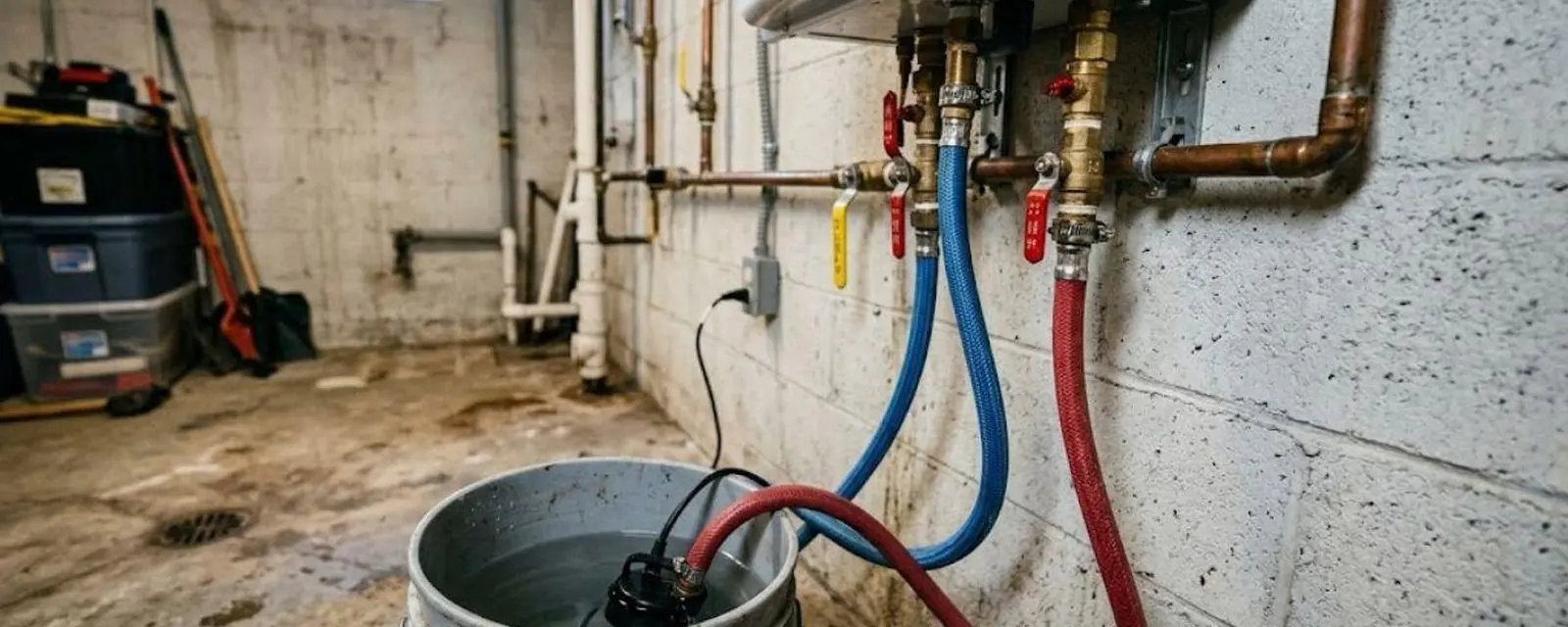
A tankless water heater leaking in Chesterfield, MO usually comes down to one of five places. A loose fitting at the bottom, a clogged condensate drain, a cracked heat exchanger, a relief valve that is passing water or a scale buildup that has started eating through parts. Each has a different cost and a different urgency.
First, stop the water. Close the cold water shutoff valve below the unit, turn off the power at the switch or breaker and, for a gas model, close the gas valve. Then read on to work out what you are dealing with.
What to shut off, in this order
Close the cold water isolation valve
Most tankless units have service valves under the unit. Turn the cold side handle a quarter turn so it sits across the pipe. This stops fresh water from entering.
Close the hot isolation valve
Shutting the hot side stops water from the house flowing back through the unit if a pressure change pushes it.
Cut power
Switch off the unit and flip the breaker if it is dry and easy to reach. Do not stand in water to do it.
Close the gas valve on gas models
Turn the gas handle so it is crossways to the pipe. If you smell gas at any point, leave the building and call the gas utility or 911 first.
Contain the water
Put a pan or towels down, then take photos of the leak point and any error code on the display before you call.
Where the leak comes from and what it means
Match what you see to the likely source. The color and timing of the water point to the cause.
| What you see | Likely source | Repair or replace |
|---|---|---|
| Drip at the pipe connections underneath | Loose union, worn washer or failed fitting | Often a repair: new gaskets or fittings |
| Slow drip from the pressure relief valve line | Valve weeping from high pressure or debris | Repair: replace valve, check thermal expansion |
| Cloudy, slightly acidic water from the exhaust or drain on a condensing unit | Condensate drain clogged or neutralizer full | Repair: clear drain and replace neutralizer media |
| Water inside the cabinet near the heat exchanger | Cracked or pinholed heat exchanger | Usually replace the unit or the exchanger |
| Water with white crust around joints | Scale attacking seals and fittings | Repair after descaling, check for hidden damage |
| Steady flow from the bottom of the case | Internal failure or failed inlet filter housing | Repair or replace after a closer look |
Water running down the wall from above the unit may not be the heater at all. Check for a leaking pipe or a bad venting joint.
How we trace the leak instead of guessing
The first move is to dry the unit and every pipe around it, then watch the base for fresh water with a flashlight and a paper towel. A drip that returns within minutes tells you which fitting to open. A drip that only shows up after a hot water draw points to expansion or a valve.
We use a pressure gauge on the supply line to look at static pressure, because high pressure can cause a relief valve to weep without any part being broken. A moisture meter helps find hidden moisture in the wall behind the unit.
On condensing models, we look at the condensate trap and the neutralizer before touching anything else. These are the most common and cheapest fix, and a clogged one makes it look like the heater itself is failing.
Tankless unit leaking now?
Shut the gas or power and the water valves, then call.
The five usual suspects in more detail
Fittings and unions
Vibration, heat cycles and old washers loosen connections. If the drip is at a union, replacing the washer and tightening it correctly often ends the leak.
Condensate drain
High-efficiency units make acidic water as they cool exhaust gas. A blocked line sends that water back into the cabinet or onto the floor.
Pressure relief valve
A valve that drips usually responds to high water pressure or has debris on the seat. Replacing the valve is not a fix if the pressure is the real cause.
Heat exchanger
Hard water scale and freezing can crack the exchanger. Water leaking from the core of the unit rarely returns to service.
Scale and corrosion
Mineral buildup narrows the flow and attacks seals. It builds quietly for years and then shows up as a leak.
Chesterfield water hardness and what it does to a tankless unit
Missouri American Water supplies most of St. Louis County. In its 2021 St. Louis region water quality report, hardness at the Missouri River facilities ran from 76 to 170 mg/L as calcium carbonate, about 4.4 to 9.9 grains per gallon. The Meramec River facilities ran from 66 to 148 mg/L, or about 3.9 to 8.7 grains per gallon.
That is moderately hard to hard water, and it leaves scale on heating surfaces and in tankless heat exchangers. Scale cuts flow, overheats parts and can shorten the life of seals. Ask Missouri American Water for the latest report and which treatment plant serves your address, and think about a flush schedule or a water softener or filter for the line feeding the heater.
Source types: utility water quality report.
Fix it or replace it
Age matters less than the part that failed. This is how we think about it.
Repair makes sense when
- The leak is at a fitting, union or valve
- The condensate drain or neutralizer is blocked
- The relief valve is weeping from pressure
- Descaling brings flow back to normal
- The unit is otherwise running well
Replacement makes sense when
- Water comes from inside the heat exchanger
- Repeated leaks follow one repair after another
- Scale has damaged more than one part
- Repair cost approaches the cost of a new unit
- The unit cannot be serviced for a part
What changes the cost of a tankless leak repair
The cause, not the brand, sets the price. A union washer and a heat exchanger replacement are different jobs.
Homeowners policies commonly cover sudden accidental water damage but not wear or maintenance. Document the leak with photos and call your insurer if the water reached the floor or wall.
Want the real number for your job? Call the 24/7 line, describe the work, and hear a clear price before anything starts.
Getting the unit looked at
If the leak is at a fitting or valve, a plumber can often repair it the same day when a slot is open. Our tankless water heater work covers diagnosis, descaling and repair. If the exchanger has failed, we can talk through water heater replacement and whether another tankless unit or a tank suits the house.
We serve nearby towns too, including Creve Coeur and Town and Country. Call the 24/7 line if the leak is steady, near electrical parts or flooding a finished space.
Questions readers ask
Most often a loose union, a worn washer or a blocked condensate drain. Dry the area and watch where fresh water appears first.
It can be. Water near the power connection or gas valve is a hazard, so shut off the water and power and call a plumber. Leave the building if you smell gas.
Usually not in a practical way. A cracked exchanger often means replacing the unit, or the exchanger if it is a supported part.
High water pressure, trapped expansion or debris on the seat. A pressure gauge on the supply line shows whether the valve is the problem or just reacting.
Missouri American Water's 2021 report put hardness at roughly 3.9 to 9.9 grains per gallon across its St. Louis facilities. That scales heat exchangers and fittings over time, so ask the utility for its latest report and descale on a schedule.
Reference points for this guide: The Uniform Plumbing Code (UPC) and the International Plumbing Code (IPC) are the model codes most U.S. jurisdictions adopt, and the local permitting authority decides which edition and amendments apply. Water hardness figures come from Missouri American Water and its 2021 water quality report for the St. Louis region. This guide is general information and does not replace a visit.