
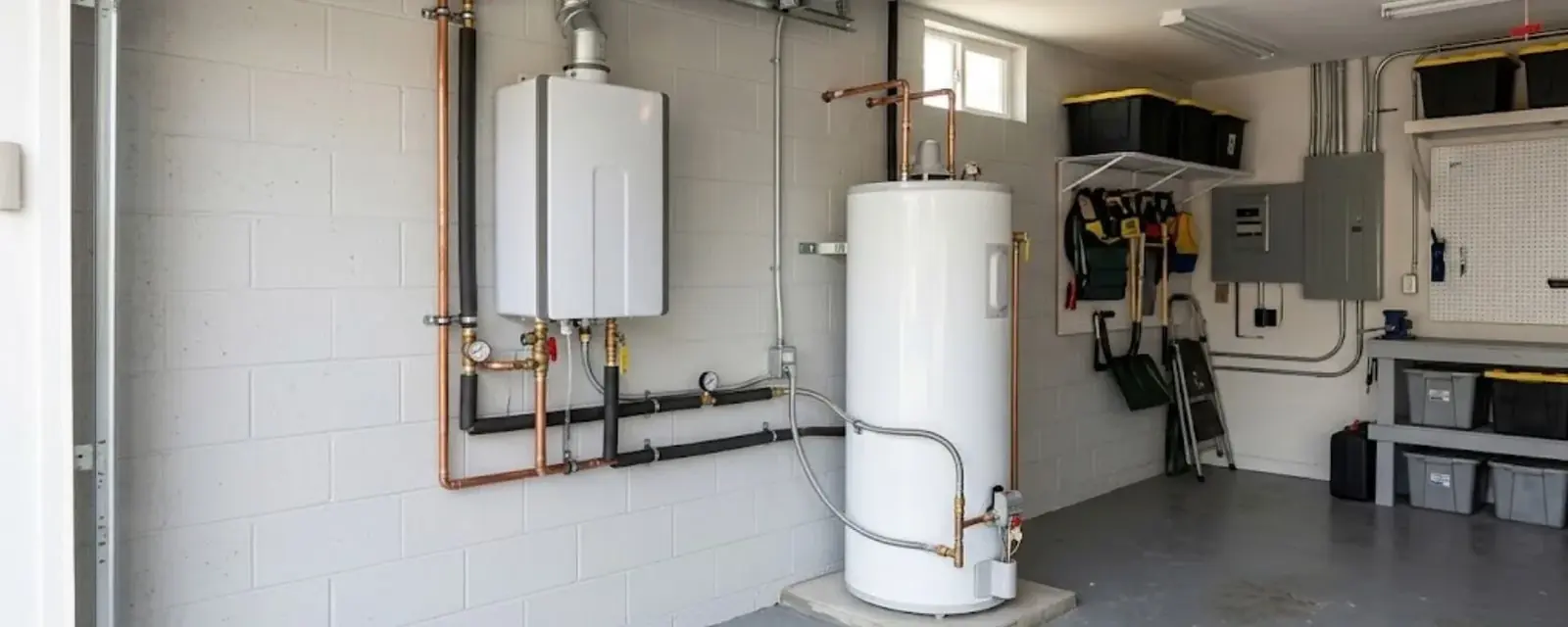
The tankless water heater you need depends less on brand than on four things your house already has: a fuel source, a place to vent exhaust, enough gas or electrical capacity and room on the wall. In Chesterfield, MO, most homeowners end up choosing between a gas condensing unit, a gas non-condensing unit or an electric unit, with a small point-of-use heater as a fourth option for a single far bathroom.
Each type has trade-offs in installation cost, running cost and upkeep. Below is a side-by-side comparison, then the practical checks that decide whether a model will fit: venting, gas line size, panel capacity and maintenance.
The four main types side by side
Use this as a starting map. Final selection needs a look at your home.
| Type | Best for | Main trade-off |
|---|---|---|
| Gas, condensing | Whole house with high demand | Needs a condensate drain and a gas line that can carry the load |
| Gas, non-condensing | Whole house where an existing metal vent is usable | Hotter exhaust needs stainless or specified vent material |
| Electric, whole house | Homes without gas or a good vent path | Large electrical draw and breaker space |
| Electric, point-of-use | One bathroom, bar sink or a far fixture | Limited flow, not meant for the whole house |
Flow, climate, fuel prices and local rules all shift the best choice, so treat this as a map, not a verdict.
Condensing versus non-condensing gas units
Condensing gas
- Captures more heat from exhaust, so it uses less gas for the same hot water
- Exhaust is cooler, so it can often vent through plastic pipe such as PVC, CPVC or polypropylene, depending on the model
- Produces acidic condensate that must drain to a floor drain, a condensate neutralizer or similar
- Typically costs more to buy
Non-condensing gas
- Lower purchase price in many cases
- Exhaust is hot, so venting usually needs stainless steel or another approved material
- No condensate to drain
- Uses more gas for the same output and often has a shorter efficiency edge
The four site checks that decide which unit fits
A model that looks perfect on paper can fail at the first of these.
Venting path
The exhaust needs a straight, short run through a wall or roof with the right clearances. A long path may limit your choices.
Gas line size
Tankless units draw far more gas at once than a tank heater, so an old line sized for a tank may need upsizing.
Electrical panel capacity
Whole-house electric units can draw well over 100 amps combined, so panel space and service size matter.
Wall space and clearances
Units mount on a wall with required distances from combustibles, windows and each other.
Water quality
Harder water scales the heat exchanger, so plan for descaling or a treatment device.
Choosing between models?
Fuel, venting and flow decide the shortlist before brand ever does.
What Chesterfield homeowners should check before buying
The City of Chesterfield contracts with St. Louis County for permitting and inspection, and its Department of Planning handles zoning approval. Permit rules vary, so ask the City or St. Louis County before work that may need a permit, since a new vent, gas line or electrical circuit may be involved.
Hardness matters for upkeep planning too. Missouri American Water's 2021 St. Louis region report shows hardness across its river sources of roughly 3.9 to 9.9 grains per gallon. That is enough to scale a heat exchanger over time. Ask Missouri American Water for the latest report and which treatment plant serves your address.
Source types: city website, utility water quality report.
Gas line upsizing and why it surprises people
A tank water heater burns gas slowly and steadily. A tankless unit fires hard the moment you open a tap. That jump in demand is why a gas line sized for a tank often needs a larger pipe from the meter or a larger regulator.
Other gas appliances share the same line, so the plumber must add up the furnace, range and dryer too. If the line is too small, the unit shuts down or shows errors under load. Ask for the gas line check before you pick a model, since upsizing can add as much to the project as the heater itself. Our plumbing installation team handles gas piping work along with the unit.
Electric units and the panel question
An electric tankless heater has no flame, no vent and no gas line. That sounds simple until you read the amperage. Big whole-house units may need several double-pole breakers and heavy wire, and some homes simply do not have the spare capacity.
Smaller electric units suit a single bathroom or a bar sink. If you have a gas furnace and a gas range, a gas unit often fits the house better. If you have no gas, electric is the only tankless route, and an electrician should check the panel first.
A practical way to choose your model
List your fuel and what the house can support
Note gas availability, panel size and where the old heater sits.
Estimate peak hot water use
Add up fixtures that run together and compare to unit ratings.
Look at the venting route
Decide whether a vent can reach outdoors with legal clearances.
Compare install cost, not just the unit price
Gas line, vent, drain and electrical work can outweigh the model price.
Plan for yearly flushing
Budget the time or a service visit for descaling.
What shifts the total cost of a tankless switch
The unit price is only one line on the bill.
Homeowners policies commonly cover sudden accidental damage but not wear and maintenance, so check your policy. We give a clear price before work starts.
Want the real number for your job? Call the 24/7 line, describe the work, and hear a clear price before anything starts.
Maintenance you sign up for with any tankless unit
Every tankless heater needs periodic flushing to remove scale, and the manufacturer's manual tells you how often. Many units have service ports for a descaling flush with vinegar or a descaling solution, and an inlet screen to clean. Skipping this step is the most common reason a good unit fails early.
If you are ready to buy, our tankless water heater work includes helping you match a model to your house. We also serve homes in Ballwin and Town and Country. If your tank has already failed, call the 24/7 line.
Questions readers ask
Often, if you run lots of hot water and have a drain for the condensate. The gas savings add up over time, but the higher purchase price and drain requirement are real trade-offs.
Sometimes. Venting, gas line size, electrical supply and clearances decide it, so a plumber should check the spot before you order.
Many homes do, because tankless units draw much more gas at once than a tank. A plumber adds up all gas appliances to see what the line can carry.
No. Point-of-use units are small and best for one bathroom or a distant sink. A whole-house demand needs a larger gas or electric unit.
The City of Chesterfield contracts with St. Louis County for permitting and inspection. Ask the City or County before work that may need a permit.
Reference points for this guide: The Uniform Plumbing Code (UPC) and the International Plumbing Code (IPC) are the model codes most U.S. jurisdictions adopt, and the local permitting authority decides which edition and amendments apply. Water hardness figures come from Missouri American Water and its 2021 water quality report for the St. Louis region. This guide is general information and does not replace a visit.